Kayak or Stand up Paddleboard?
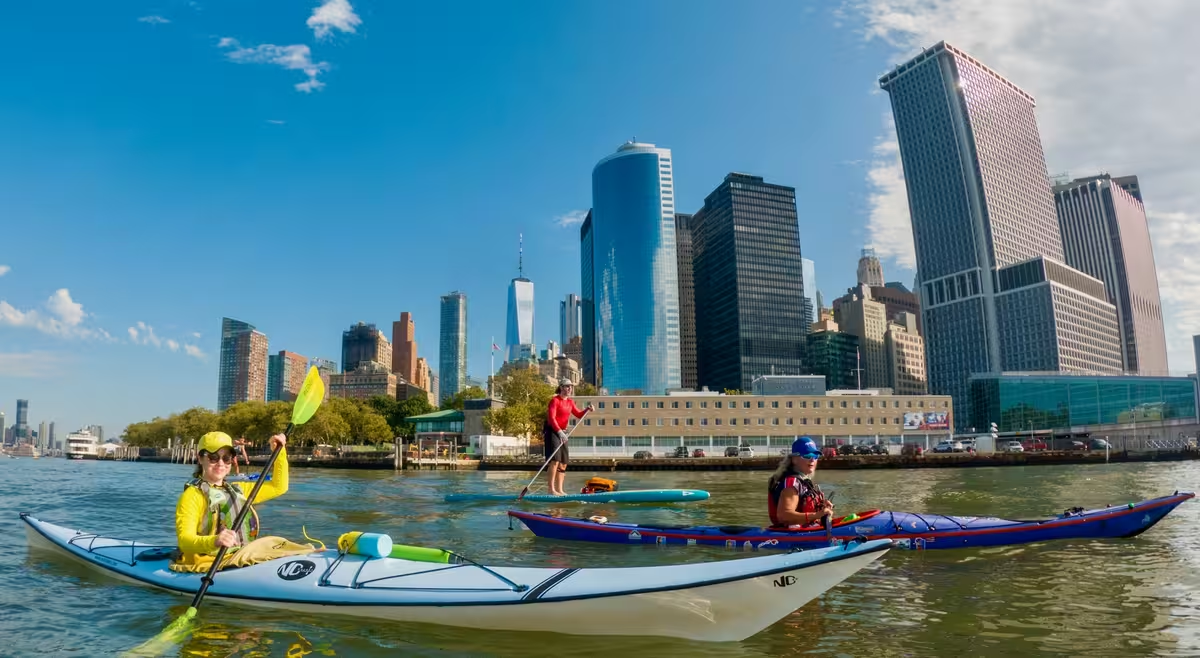
Which One Should You Choose: Kayak or SUP?
If you’re brand new to paddling and conflicted about which paddling discipline to learn, I’m here to help. As founder of Manhattan Kayak Co, I have a lot to share on this topic.
First, for fitness: In both kayaking and SUP, learn to use your whole body and lots of torso rotation (we offer Kayak and SUP 1-2-3 where anyone can learn this). You get an excellent core workout and it’s a lot of fun. Burn ~500 calories in a normal guided trip and ~1,000 calories in a race training session. If you don’t learn technique, you’ll likely overuse your arms, the fitness benefits will be elusive, and you’ll be moving too slowly to enjoy the ride.
In debating kayak and SUP, I remember my dad, Dieter Stiller, a pioneer in bringing kayaks to the United States via the Klepper Kayak Company. From his perspective, the kayak is superior in races and expeditions. It offers a stable center of gravity and the efficiency of a double-bladed paddle. The sleek closed-deck, low windage, and the rudder make the kayak into an athlete’s boat. As a 12 year old kayaker in the Adirondacks, I did circles around the canoes!
Freestyle Kayaking
Eric EJ Jackson, a pioneer in freestyle kayaking, can do nearly anything an Olympic gymnast can do, and in 10-foot waves. I’ve been honored to learn modern freestyle kayaking from him.
One of the tenets of freestyle kayaking is using your paddle vertically, as a combination of a keel and underwater sail. Pressure variances between the paddle blade and river current will steer the kayak from point to point, instead of trying to overpower a force that cannot be overpowered.
One of EJ’s drills in his Strokes and Concepts videos and book involve paddling 180 degrees around a static kayaker in three strokes, and coming out with more speed and with no side-slip. I learned to use a kayak paddle in a vertical plane, using one blade in the water to make the majority of the turn.
The Advent of SUP
In the mid to late 1990’s, Laird Hamilton and friends including David Kalama, used longboards with outrigger canoe paddles and SUP began. The secret surfer living inside me said, “Wow, I can use a paddle with a surfboard!” and I bought my first three C4 Waterman boards under guidance of C4 co-founder Todd Bradley. Manhattan Kayak was officially riding the SUP wave. Soon enough, surfer turns were all the rage in our Hudson River cove. And they’re a ton of fun!
It didn’t take long before our kayak instructors started loving SUP. Within a year, we were doing boot camps, SUP yoga and circumnavigating Manhattan by SUP. The boards proved to be versatile and easy to pull from the rack, and cradle under one arm and launch. Also, friends with back and shoulder injuries tell me they don’t feel the pain on a SUP (same goes for my injuries). People with knee injuries can have a harder time at the beginning of their learning curve because they will need to kneel on their board before they know how to stand.
We practiced and soon we were going on trips with sea kayakers, though we fell behind kayakers when against strong headwinds. We even learned to surf the wind versus tidal current waves. Life on the water is good!
Atlantic SuperGirls: From NYC to Miami
Six years after the first SUP landed on our Manhattan doorstep, two of our top guides, Julieta Gismondi and LouAnne Harris paddled two 12’6″ BIC Wing SUP’S 1,500 miles, self-supported from our Pier 84 boathouse to Miami. The epic story was recounted in SUP The Mag, The Mullet, and W42ST Mag among others. It was a grand journey by any measure. And, as the world keeps turning, a few months after her return, Julieta got into our new Epic V7 Surfski and had a big grin on her face. It was the sensation of paddling really fast again.
Love for All Paddling Craft And What Each Type Can Do!
SUP helps me and my team more fully understand and appreciate the great world of paddling. It made us more dynamic with single- and double-bladed paddles and the vast world of craft designs.
So, Which One DO You Choose?
My recommendation is to find your local paddling school and take lessons to learn good technique. If a certain type of craft is easier to find, that’s a cue on which type may be best for your area.
Remember these few truths:
-
- If you’re near a large lake or coastal region and afraid to fall: go with a sea kayak.
- If you’re near a whitewater river and that intrigues you: go with a whitewater kayak. (Learn how to paddle very well first!)
- If you live near flat and calm clear water: go with a SUP.
- If you’re a surfer, dancer, or enjoy balance challenges: go with a SUP.
- Finally, you may want to travel with your vessel to great waters far and wide. There are portable versions for all of those!
Still can’t decide? Come to the cove and try both. Our Basics 1-2-3 series is designed to give you total confidence on either craft.
ENJOY!
Eric Stiller, Founder
Manhattan Kayak Co