Why Stand-up Paddleboarding Is New York City’s Ultimate Outdoor Cross-training Workout
Best for: Stand-up paddleboarding cross-training, athletic endurance, and core balance conditioning.
🏄🏽♂️ The Quick Skim
While landlocked New Yorker’s view a room full gym machines or stuffy studio classes as their primary fitness options, the true magic of stand-up paddle boarding lies in its unique ability to serve as the ultimate low-impact,multi-intensity cross-training playground right on the water. You don’t have to choose between a exhausting run that pounds your joints staring at asphalt or a passive recovery session with candles and chanting. By learning our fluid forward stroke technique, you can redline your engine like a performance car while dynamically using your legs, hips, and core in a perfect, full-body kinetic chain. Or-downshift to cruising mode and rhythmically glide in zone 1 or 2 to recover and reset your nervous system. Whether you are a Type-A marathon runner, a HYROX athlete looking for an unfair cross-training advantage, or a casual seeker looking to find your parasympathetic peace on a sunset cruise, your journey to total mind-body flow begins by installing the foundational mechanics in our SUP Intro class or stepping up your efficiency in season membership training package—the mandatory launchpads that unlock our high-intensity weeknight training and weekend open-river trips.
Since Surf Legend Laird Hamilton’s Paddle in New York Harbor in 2008, the Stoke Was Lit!
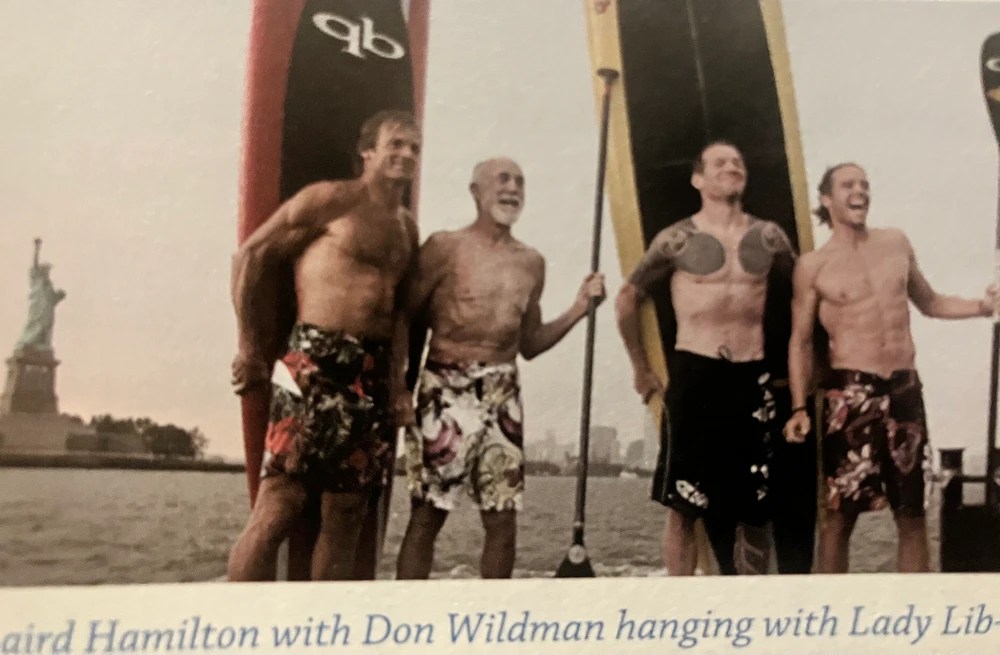
The Next Wave of Hawaiian Paddling Spirit Arrived and Changed What Paddling Means in NYC Forever!
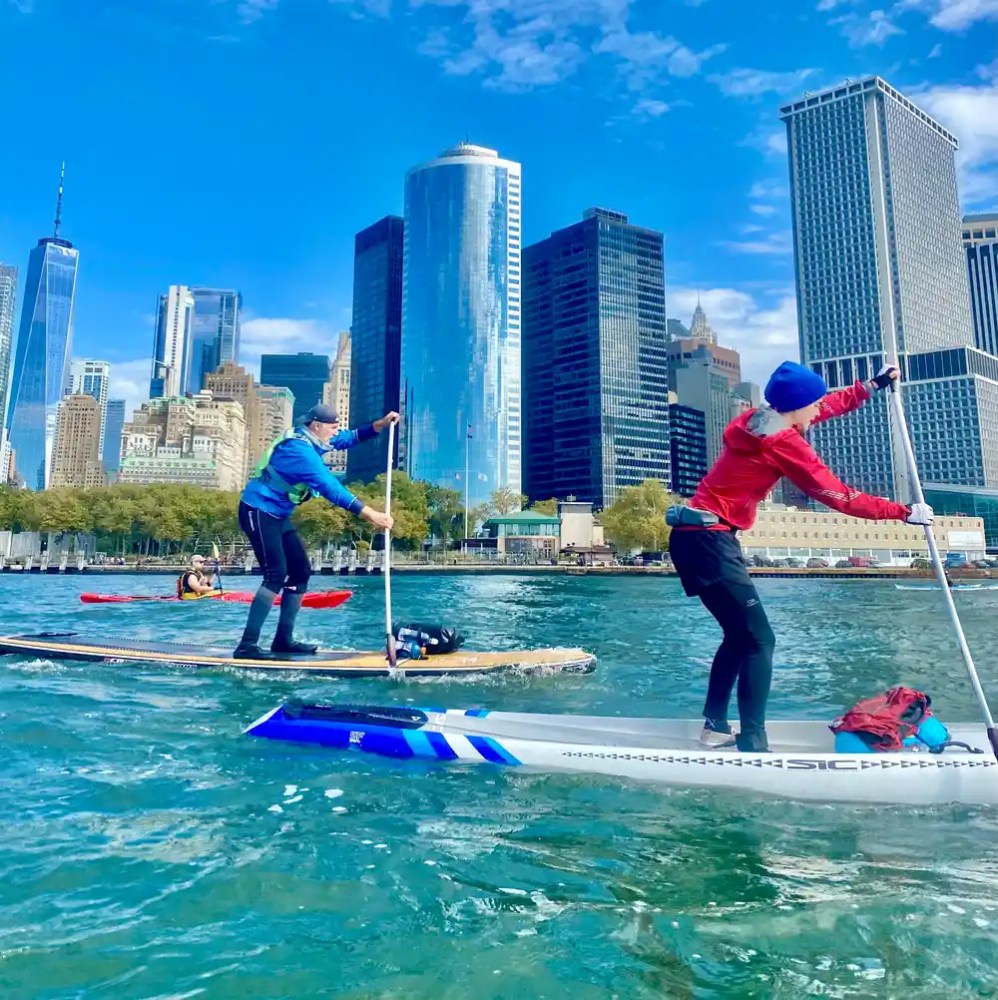
By Eric Stiller (Founder)
A dozen years earlier, Roger Meyer acquired a 6-man outrigger canoe that I joined as crew at the 79th St. Boat Basin. He went on to found the New York Outrigger Club and the Liberty Challenge Race.
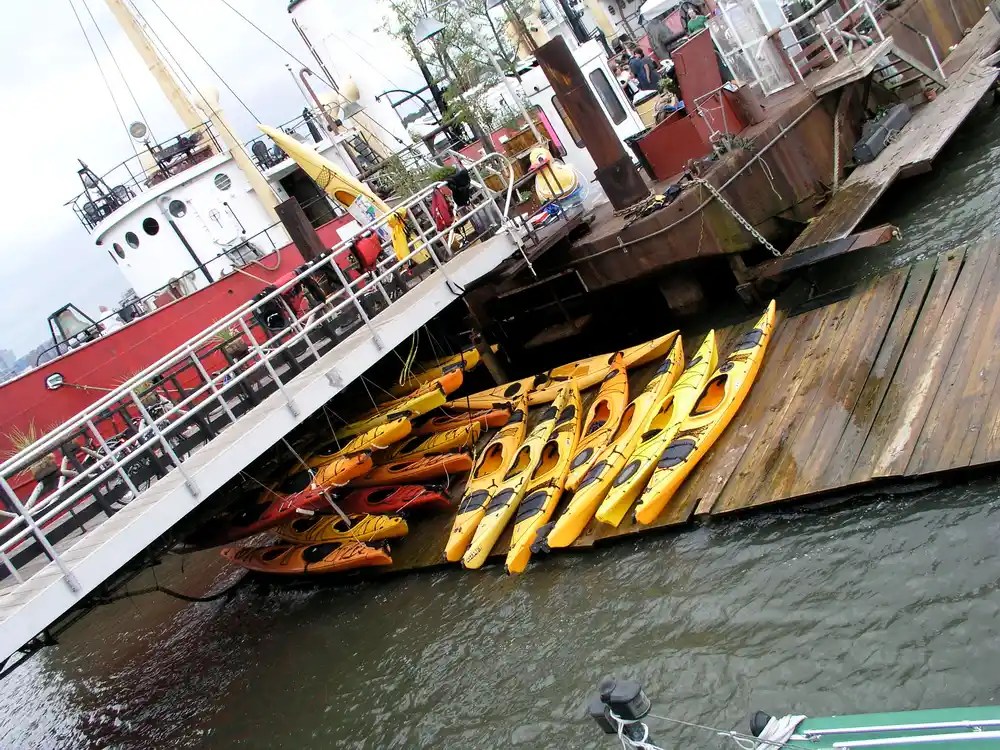
He found its first home at John Krevey’s Pier 63 Maritime (aka The Frying Pan) long before it became one of the most popular outdoor bistros and event sites in NYC.
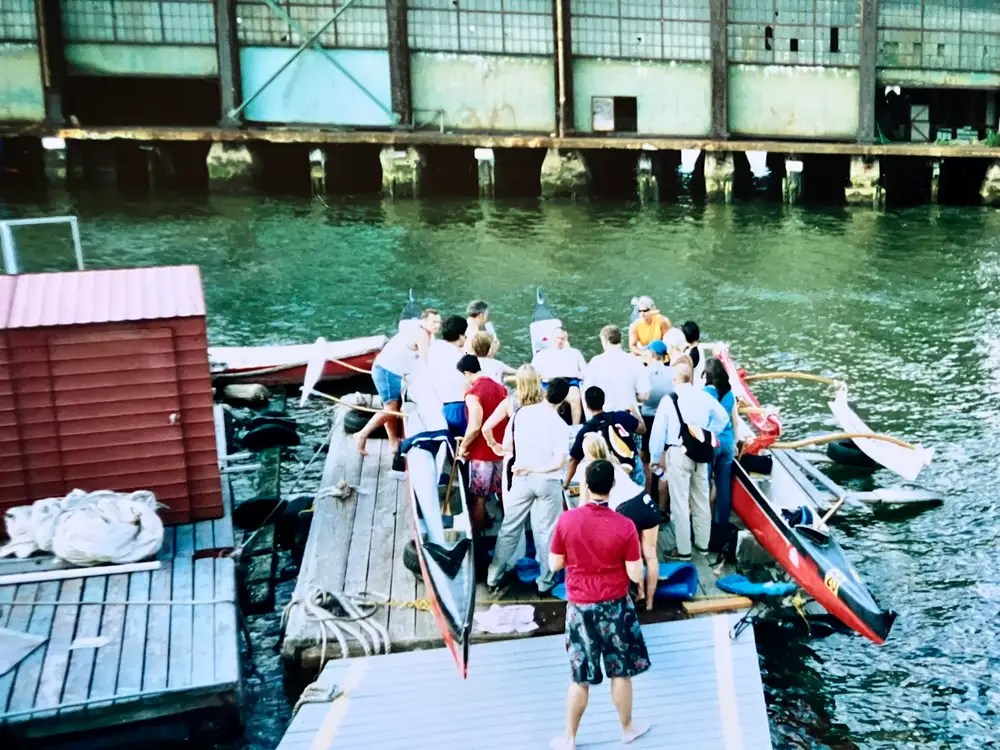
It wasn’t long before Manhattan Kayak joined him at this location.
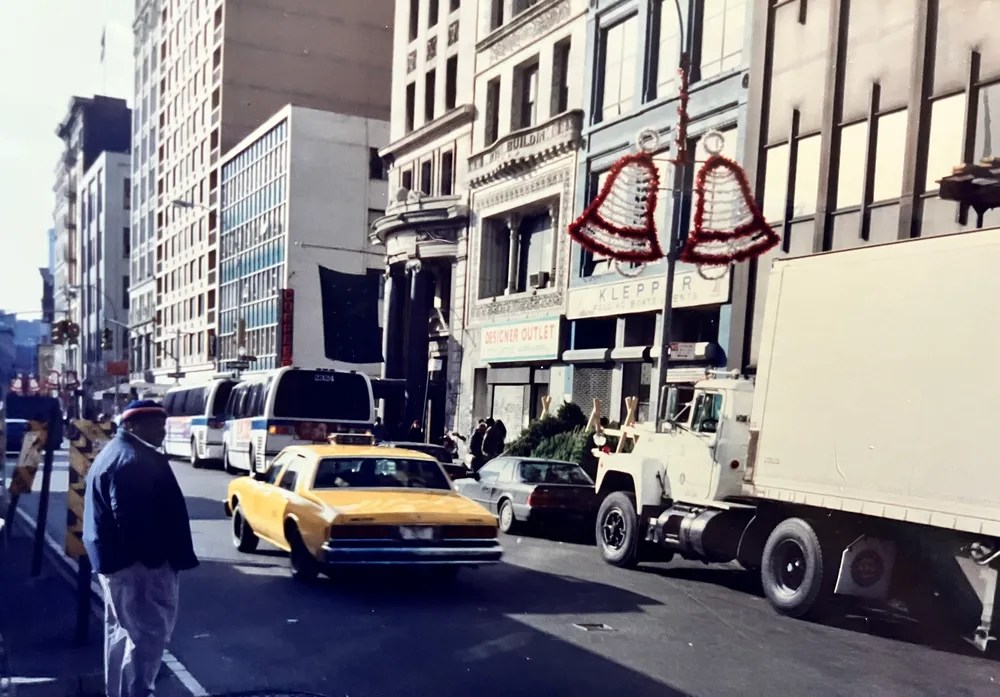
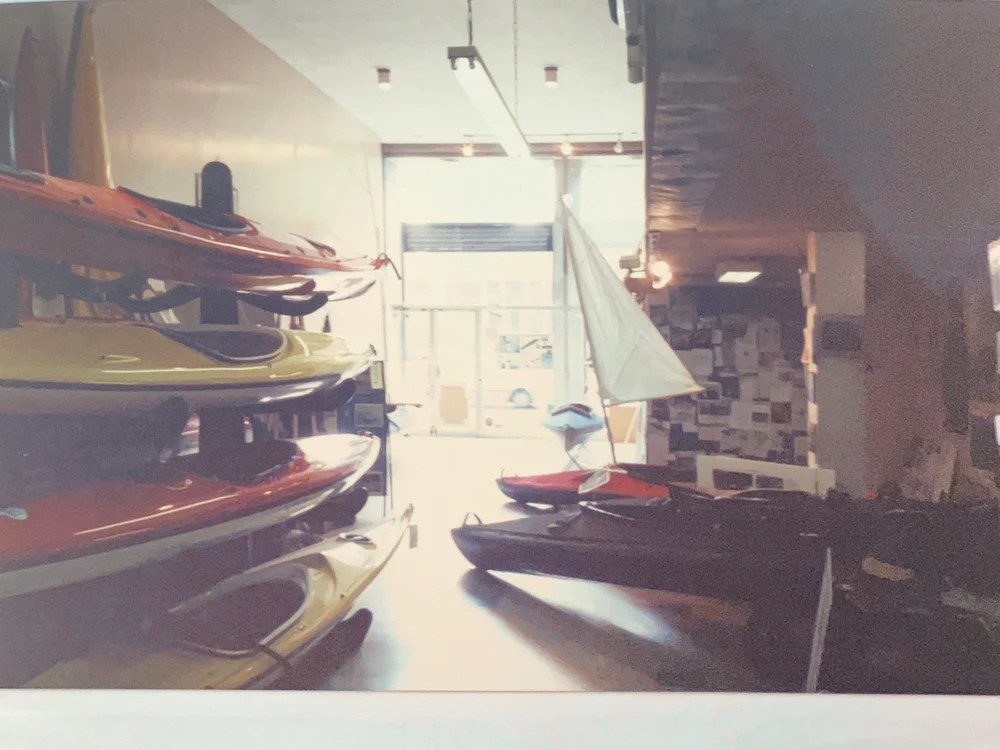
Sea kayaks had been plying NYC waters for decades through some local clubs and a number of adventurous individuals, many of whom purchased their boats from my dad’s Klepper Kayak shop on 35 Union Square West.
But single-bladed paddling via “canoe” was a rare sighting, as NYC waters had become quite dynamic since the Lenape Indians paddled here in their dugouts prior to the time Henry Hudson navigated the harbor.
However, the outrigger canoe was a completely different kettle of fish, so to speak. It was a vessel more than at home in wind and swell, holding a deep history in Hawaii.
Every time I have visited and paddled there, I could feel the presence of the various deities. These deities tested me, toppled me, and made it clear that a powerful Mana (sacred energy) existed in those waters.
It was an energy that made sure my ha’aha’a (humility) and ho’ihi (respect) were fully in line. If they were, and when combined with mahalo (gratitude), the spirit of aloha (the shared breath of life) became truly accessible.
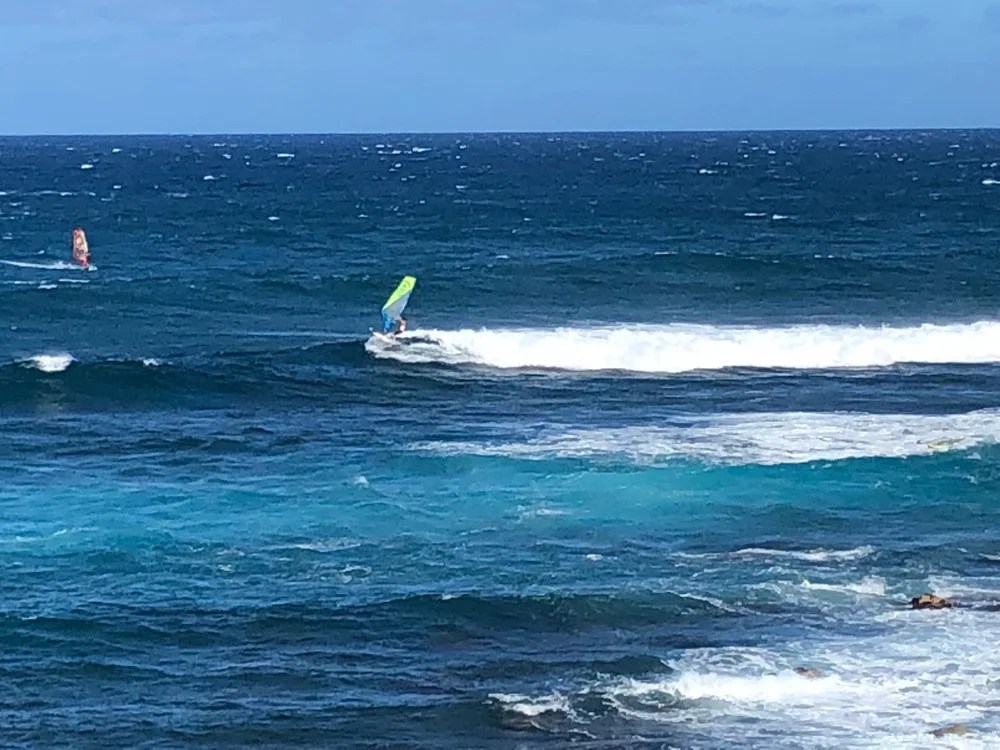
My official SUP baptism in these waters was overseen by Todd Bradley, a long-time Hawaiian waterman, surfer, outrigger canoe racer, and outrigger canoe paddle builder.
He took me on the famous Hawaii Kai run—ten-plus miles of intense downwinding. The objective here is to use the powerful wind waves of the day to get onto the even more powerful groundswell that has traveled thousands of miles across the ocean.
“Don’t just paddle straight; turn before the bottom of the wave to get onto the next one,” Todd advised.
I watched him S-turn his way forward, eventually getting further and further away. He explains his method here in detail.
Frankly, I was just trying to stay on the board and remain as connected as I could be in those legendary conditions.
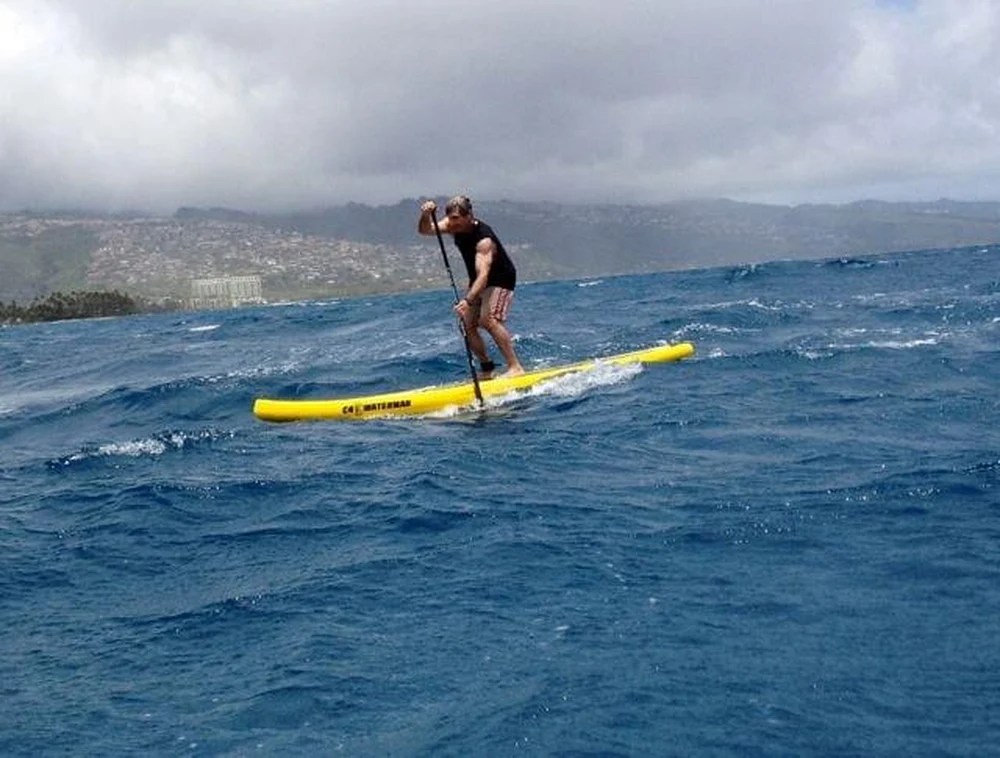
Humility? Respect? Check!
Later, Todd let me borrow his board at The Outrigger Canoe Club, where I would paddle out and ride back in on the swell. I never did take him up on his ocean break wave surfing offer, as I knew it was well beyond my pay grade at the time. I really was just learning the basics back then.
Todd was an integral part of stand-up paddleboarding’s takeoff into the mainstream. He was the founder of C-4 Waterman, whose “4 Core” motto printed on their paddles was: Balance, Endurance, Strength, Tradition.
But a year or so before this Hawaiian SUP baptism happened, a tall, tan man walked into MKC asking if we needed any guides. His name was Simon Tetlow, and he had spent a number of years kayak guiding the Na Pali Coast routes for Kayaks Kaua’i.
Naturally, I was immediately intrigued. I knew the founders of Kayaks Kaua’i, Micco and Chino Godinez. They had originally written to my dad in the late 1970s when they were contractors in Pittsburgh, asking about undertaking a major sea kayak expedition in Klepper kayaks.
From what I understand, my dad helped steer them toward the West Coast of British Columbia, encouraging them to journey from Seattle to Skagway, Alaska, along one of the most beautiful and dynamic coastlines in the world.
Micco and Chino came to NYC to meet my dad in person, get the full download, purchase two Klepper Aerius 1 folding kayaks kitted out to the gills, and off they went. After that adventure, they went on to establish Kayak Kaua’i. Here is the beginning of the “About Us” section from their website:
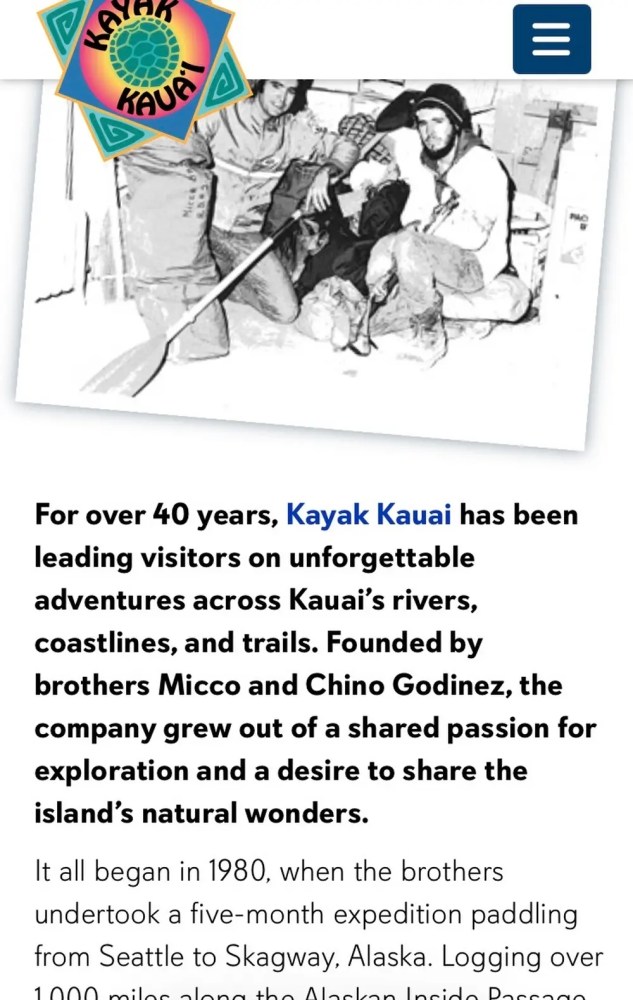
They told me when I first went to visit Hawaii to try and buy a surfski from Bob Twogood in 2001: “We blame this on your father.”
Simon and I then discussed this new sport that was all the rage in Hawaii—stand-up paddleboarding. I told him I had heard about it and was deeply interested. He knew all about Todd and C-4. Soon after, we sent Simon to the Outdoor Retailer Expo in Salt Lake City to broker a few boards for us.
Within a few weeks, the boards arrived. We slipped them out of their boxes and were completely amazed.
We stared at them like the primates looking at the monolith in 2001: A Space Odyssey. Then came the furious unpacking, accompanied by plenty of hoots and hollers, as we looked at the fins and scratched our heads trying to figure out how they attached to the board.
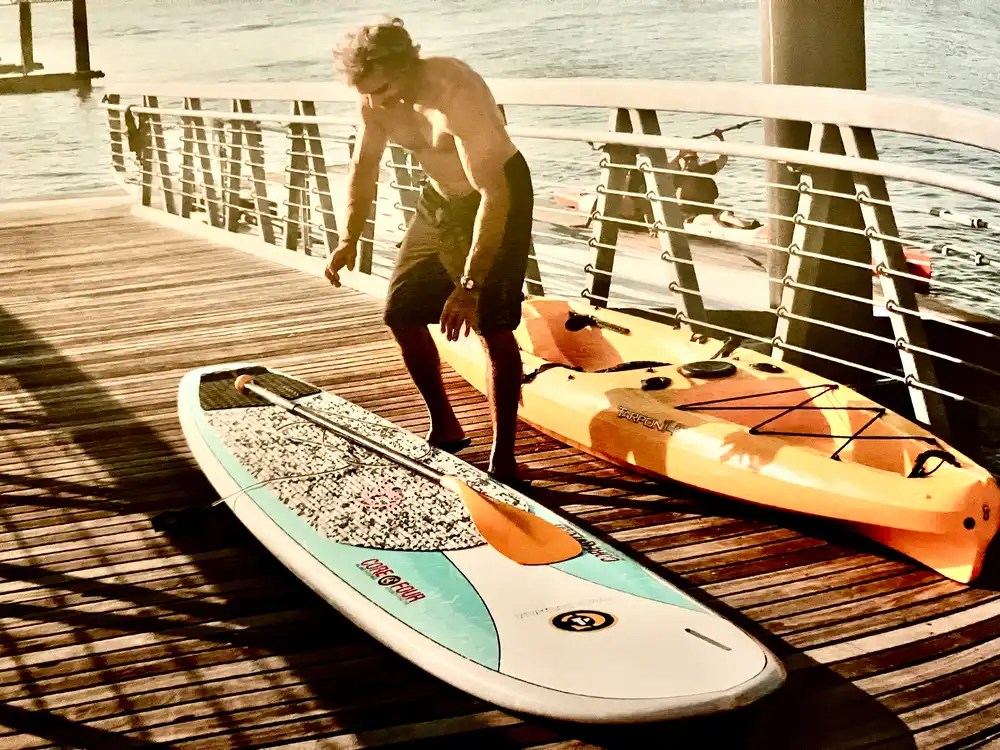
It was going to be another pair of Bradleys that got me hooked for good.
It is not completely clear how I was first introduced to Gina Bradley of Paddle Diva and her husband, Scott. I believe it was through Gina Smith, who had indirectly helped me get Manhattan Kayak into the Chelsea Piers Sports Center.
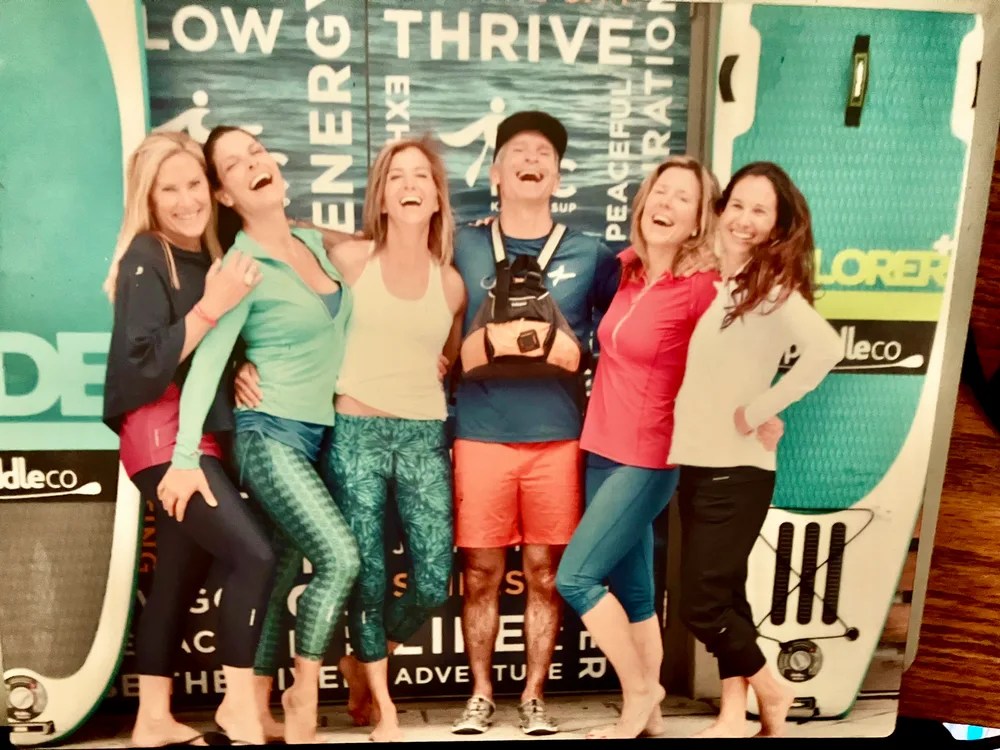
Gina Bradley (third from left) and I with a number of her Paddle Diva instructors visiting me at Pier 84 Boathouse.
In any case, Scott Bradley had been a long-time big-wave surfer, and Gina was naturally athletic. While she wasn’t quite as drawn to surfing waves on a SUP as Scott was, she immediately recognized the incredible fitness benefits of paddling it in open water around Three Mile Harbor in Eastern Long Island back in 2006. She was a true pioneer for the East Coast scene.
Gina, Scott, and to some degree myself, were early enough in the SUP revolution that Ben Marcus—a long-time surfer, surf magazine contributor, and author of The Art of Stand Up Paddling—dedicated a few pages to us for helping kickstart SUP in the Northeast.
The book is a one-of-a-kind, bible-like compendium of the sport, covering everything from history and technique to the full range of SUP design and possibilities. Full-color photos abound throughout its pages.
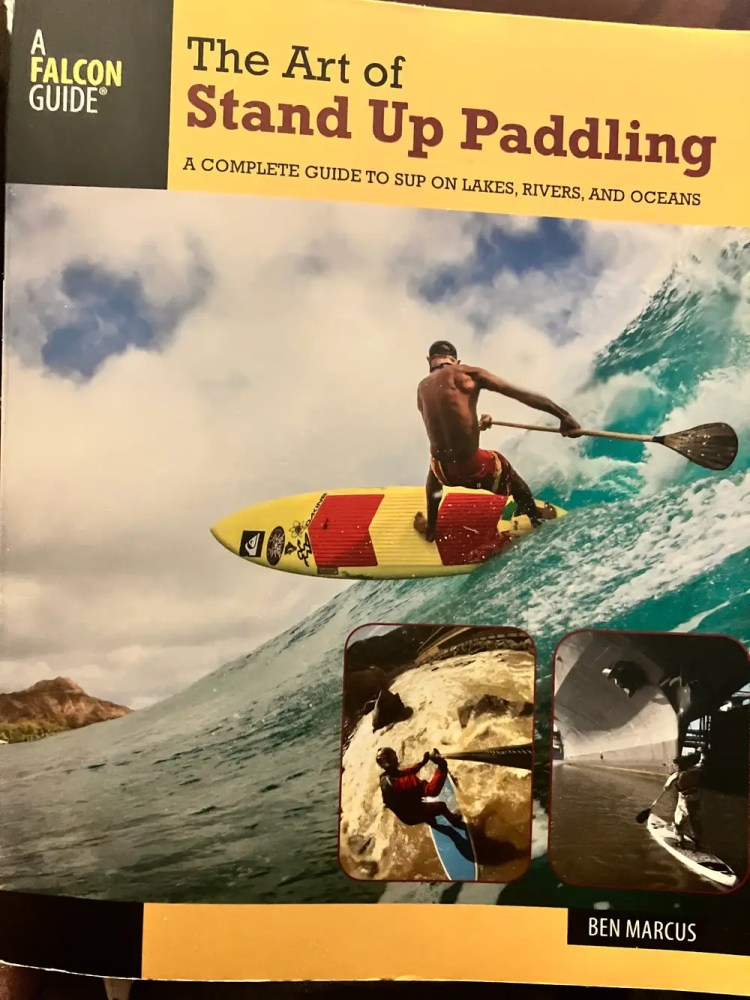
Long before the Ozempic craze, Ben penned a chapter that begins with the title:
Lose Weight How? GO SUP NOW!
He goes on to write: “If you get into stand-up paddling and do it properly and do it diligently, you will find the results from this one ‘machine’ done for an hour or two outside in the fresh air and sunshine, on the water, away from stinky gyms or your living room floor, will live up to and surpass all the TV pitchmen and women put together.”
Anyway, before you knew it, I was on an airplane to Rincon, Puerto Rico, where the Bradleys run their seasonal SUP camps.
For me, it was essentially a SUP boot camp. Scott had me riding a host of surf-style SUPs, some of which were quite experimental. There was lots of falling and lots of fun. When most of the camp members were enjoying Piña Coladas on the beach, I decided to paddle straight into a headwind for a solid hour to test a couple of theories:
A) Was it actually possible?
B) Could these vessels genuinely be good for touring on the Hudson River someday, or were they strictly for playing around and performing tricks?
The answer at the time was a tentative maybe…
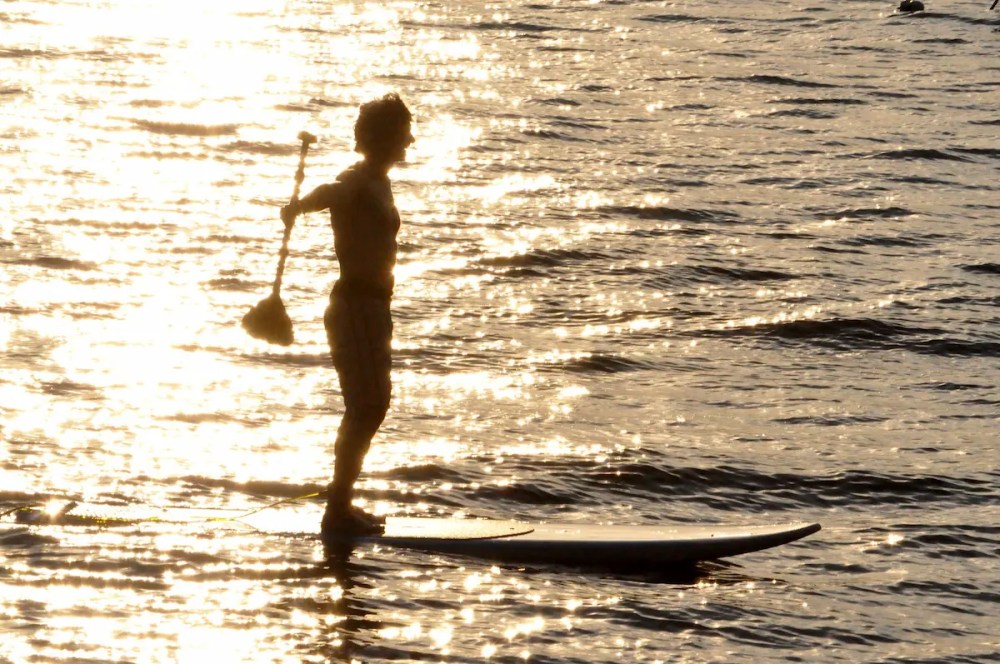
But rapid innovations in board design and forward-stroke execution would quickly shift that needle to a resounding yes.
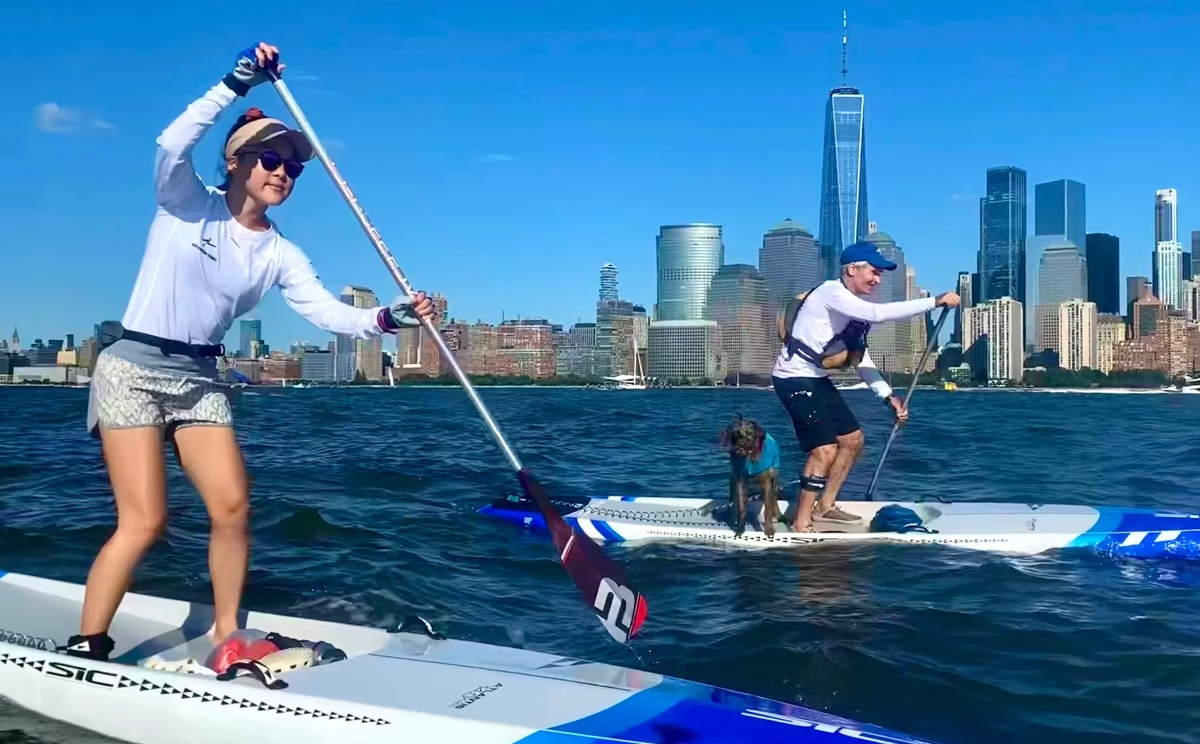
Hyunyung Boo (foreground) shares: “SUP is truly a full-body movement that I can feel from the top of my head down to all of my toes. Developing that awareness of how your body engages with the board, paddle, and water is very grounding and meditative… Competitive paddling is addictive in the same way as road racing can be, with tons of endorphins and goal-oriented progress. However, in SUP, there is the added fun and challenge of wildly different environments…”
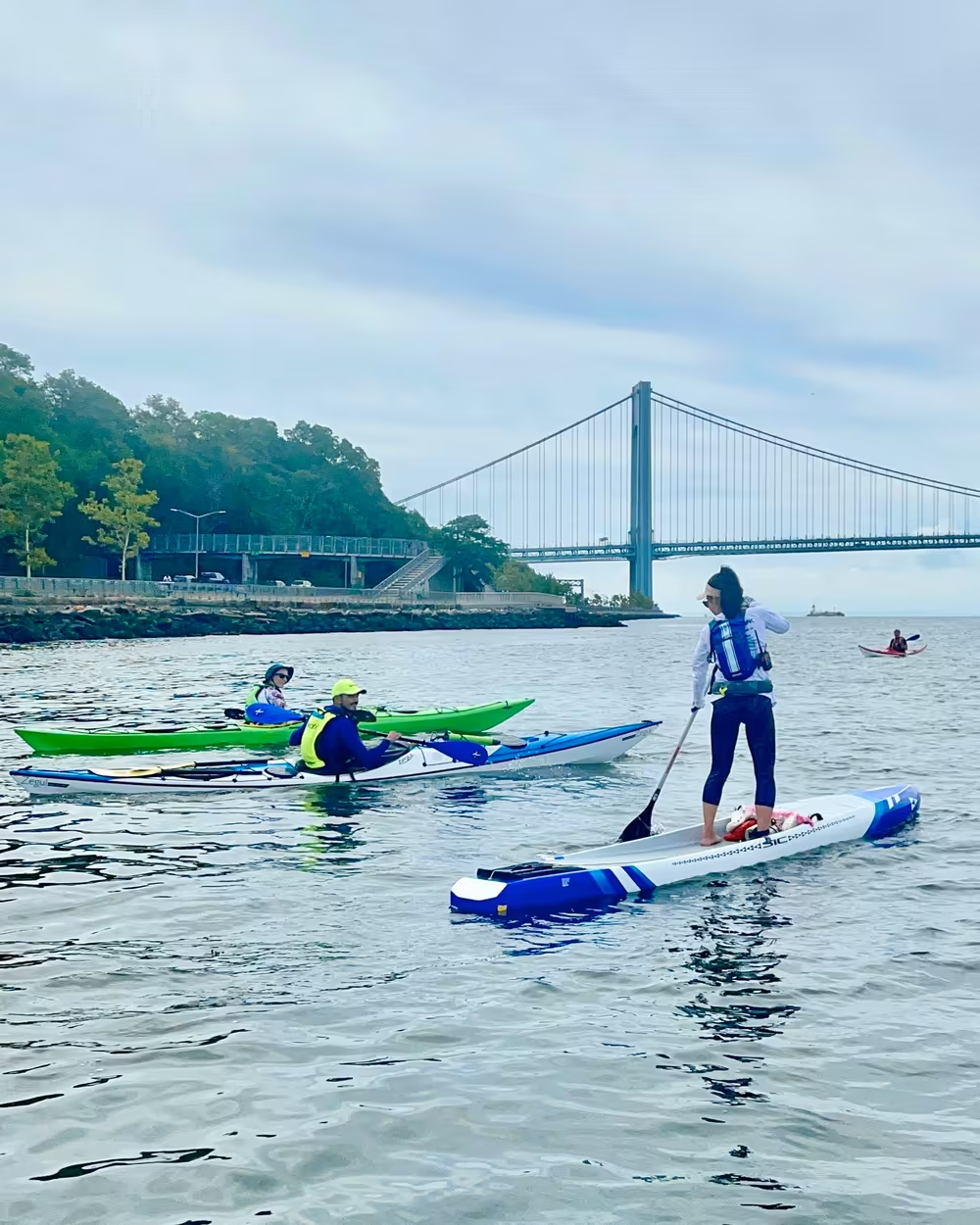
Never before had a paddling sport seen so much technological advancement in such a short window of time. The era of computer CAD drawings directly becoming active prototypes, being tested in grueling real-world conditions, and instantly iterating was amazing to watch.
Designers from every corner of the water sports industry got on board:
- Windsurfing brands
- Kayak manufacturers
- Surfboard shapers
- Outrigger canoe builders
- Even the BiC company (yes, of ballpoint pen fame!)
Everyone got busy designing and constructing high-performance SUPs.
The sport arrived like an absolute tidal wave in the 2010s across the country. Soon, races great and small began popping up everywhere. None was bigger or badder at the time than the legendary Battle of the Paddle.
On the East Coast, a completely different challenge had taken root—one that I must admit I wasn’t initially aware of. In 2007, the SEA Paddle NYC, a grueling 25-mile philanthropy race event exclusively for stand-up paddleboards, was launched by the Surfers Environmental Alliance (SEA).
Initially a modest affair with a handful of well-known surfers—including Scott Bradley, Shane Boyle, Gerry Lopez, Tom Curren, and Darrick Doerner—the roster grew to over 200 participants by 2011. By 2017, it was attracting some of the absolute best elite SUP racers in the world, including Larry Cain, Chase Kosterlitz, and Kai Lenny. It is an extraordinary event that has since raised over five million dollars for autism charities and critical ocean environmental causes.
I also hadn’t realized that my friendly downriver kayak competitor, Randy Hendrickson—founder of New York Kayak Company—had already jumped onto the SUP train via his own local Jersey surfer waterman, Mark Temme. Randy went all-in by purchasing a full shipping container of Surftech BARK Dominator 14-foot racing SUPs, accurately sensing that a massive retail wave was arriving.
Meanwhile, Todd Bradley of C-4 suggested I focus primarily on iSUPs (Inflatable Stand-Up Paddleboards). His theory was that New Yorkers would be space-constrained and highly travel-centric. He thought inflatables—of which his early iterations were easily the best on the market—would be a perfect fit for the city lifestyle.
Little did he know, his East Coast sales rep actually pushed a competitor’s iSUP on me instead, citing comparable performance at a much better wholesale price. So, I trusted him and started our fleet with Shubus, quickly learning what I’ve always known deep down: design and manufacturing quality always count.
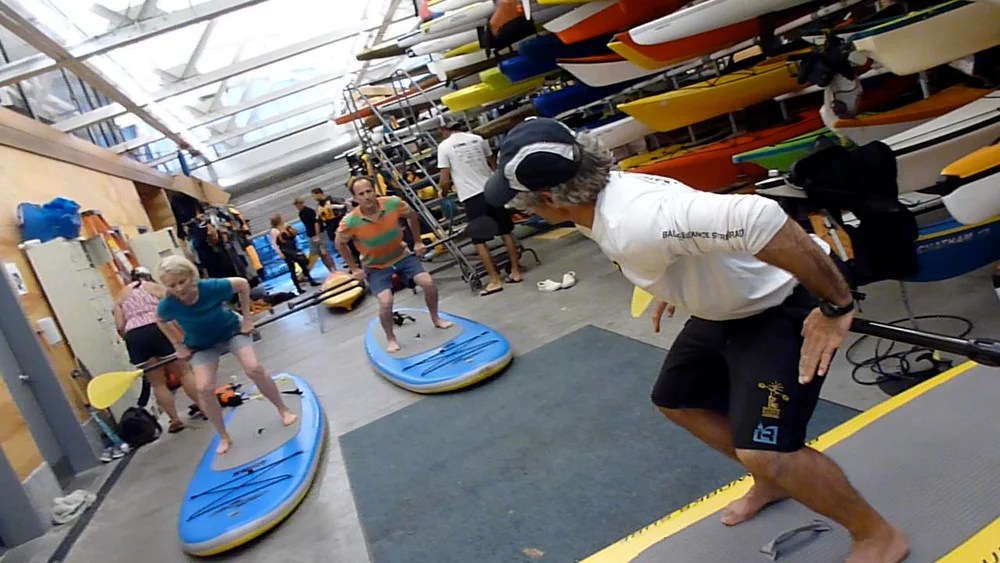
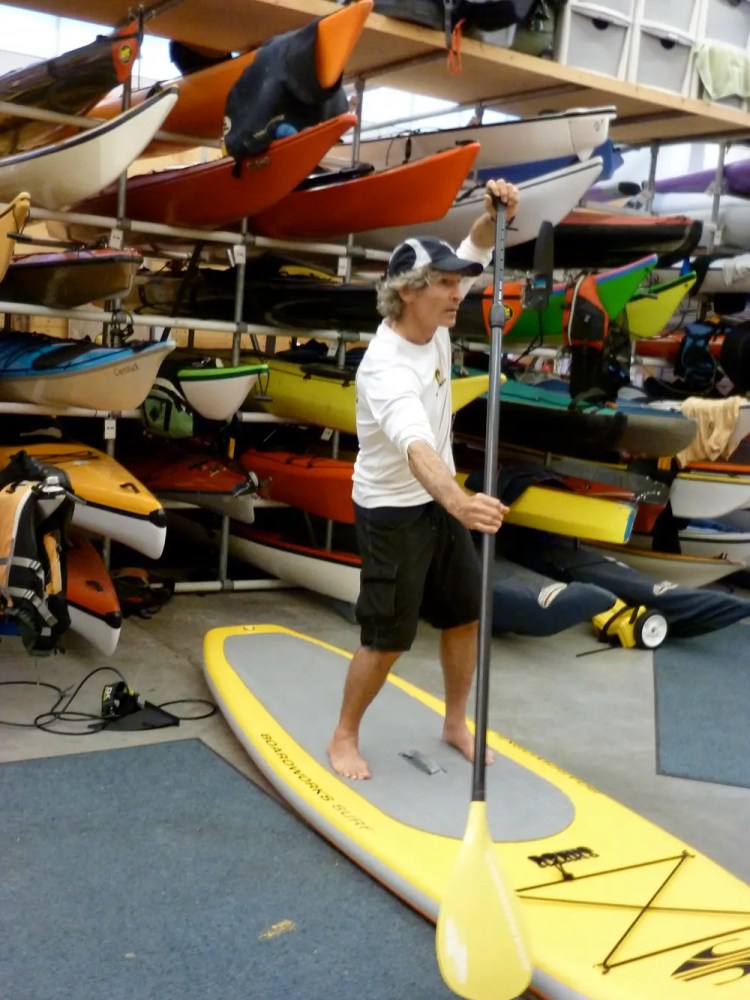
I am incredibly appreciative of my very first students who patiently learned alongside me until I finally wisened up, sold off the Shubus, and invested in a proper fleet of C-4s that offered far superior shaping and glide on the water. It was NYC’s own version of the hundredth monkey effect; our SUP bets were officially all-in.
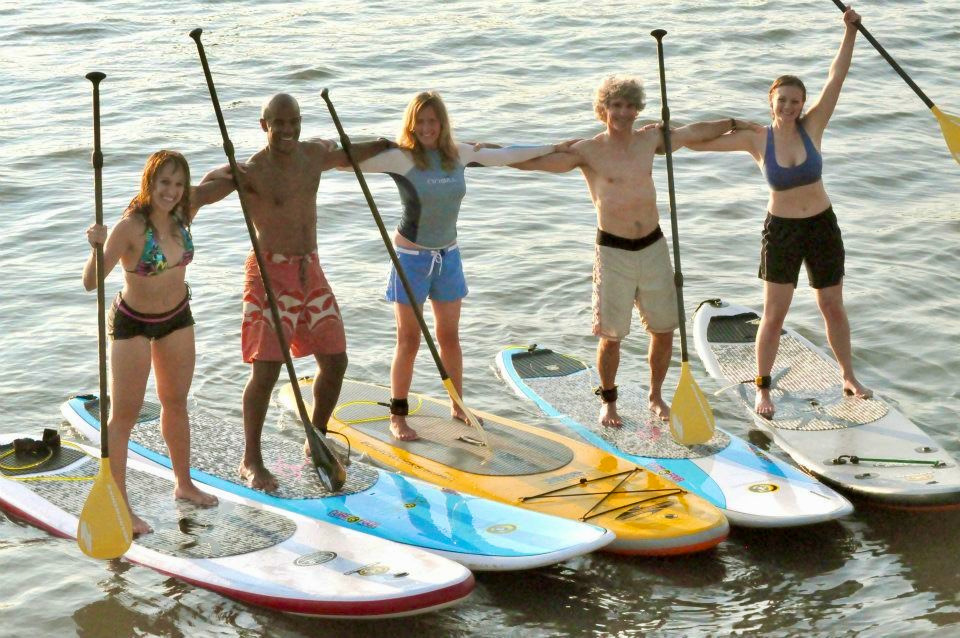
Within a year, I entered and raced in the SEA Paddle. I managed to finish the course in the top 10, clocking a time of 4:49:41 for the nearly 25-mile loop, averaging a heart rate of 168 beats per minute on a C-4 V-1 open-water race board.
It was during this race that I witnessed my new SUP hero and technical archetype: Annabel Anderson. A multi-sport powerhouse from New Zealand standing around 5’3″ or 5’4″ and maybe weighing 125 lbs soaking wet, she gave 6-foot-plus, O’Neill-sponsored heavy hitter Rob Rojas absolutely everything he could handle, crossing the line in an astonishing 4:22 and change to his 4:17:00.
I distinctly remember keeping her in my sights for the first 9 miles, confidently thinking, “Surely she cannot maintain that crazy stroke rate,” only to watch her gradually pull away and disappear into the distance.
Her technique was completely unique for its era, utilizing every single fiber of her body with every individual stroke—from her toes all the way to her fingertips—in what I can only describe as a beautifully fluid, snake-like undulation of energy repeated precisely thousands of times.
Here is how she characterizes the sport:
“SUP is a sport that is 1 part finesse, 1 part fitness, 1 part strength endurance, 1 part technique, and 1 part reading your environment. Technique is everything, and you have to be fit enough to maintain that technique when you are under high physical demand. Someone who has incredible technique and ‘feel’ for the water must have the physical conditioning to match it. Likewise, someone who is incredibly fit must also have technique; otherwise, they will resemble an eggbeater on high speed going absolutely nowhere. But if they can’t ‘read’ the water or their environment, they will always be playing catch-up in comparison to someone who can.”
Annabel would go on to become the most dominant female SUP athlete of the decade, while Rob went on to set a staggering world record by paddling for 24 consecutive hours for a cancer charity.
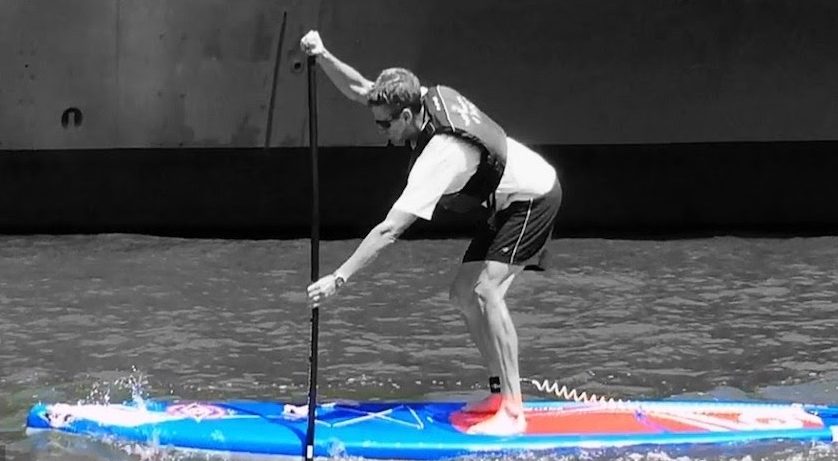
Long-time paddleboarder Peter Collins (above) perfectly captures the mental and physical reality of unlocking this level of environmental mastery on our home waters:
“Paddling the Hudson isn’t just a workout; it’s like solving a Rubik’s Cube of energy in real-time. Every stroke requires you to read the currents, the wind, and the boat wakes, aligning your body perfectly with the board to glide through the chaos. Once you dial in the technique, the river stops being an obstacle and becomes an incredible partner.”
The following year, I lined up to race again. The conditions were significantly rougher, featuring a punishing headwind for the final 10 miles. Out of more than 130 starters, only 54 people managed to cross the finish line; many competitive racers dropped out mid-way so as not to completely burn themselves out for another major points-earning race later that month. I had trained hard, armed with a new C-4 Travis Grant race board, a shorter paddle, and significantly optimized hydration and energy management systems. I cracked the top 5 this time, finishing right around the 5-hour mark.
I’m not entirely certain which year of the SEA Paddle it was, but I vividly remember a very pleasant, handsome guy smiling over at me with a genuine sense of camaraderie before we started that arduous undertaking. Later on, it clicked who that familiar face belonged to: none other than David Chokachi from the classic cast of Baywatch.
He later stored his personal board with us and launched regularly right out of the Pier 84 Boathouse. He was and remains a massive dog lover, currently dedicating a ton of his time to dog rescue operations alongside both The Sato Project and Wings of Rescue.
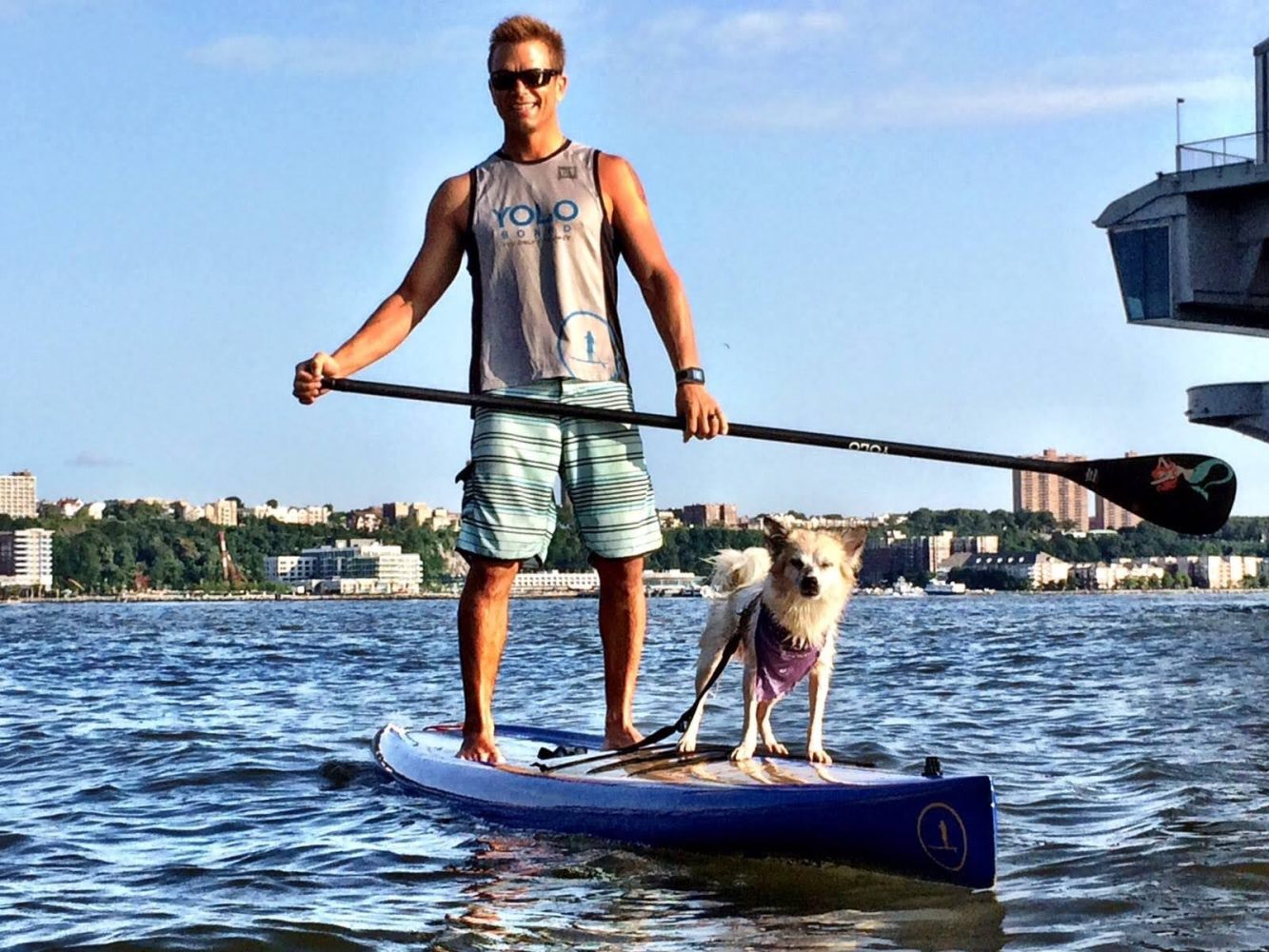
To say MKC is “dog friendly” might be the ultimate understatement of the century.
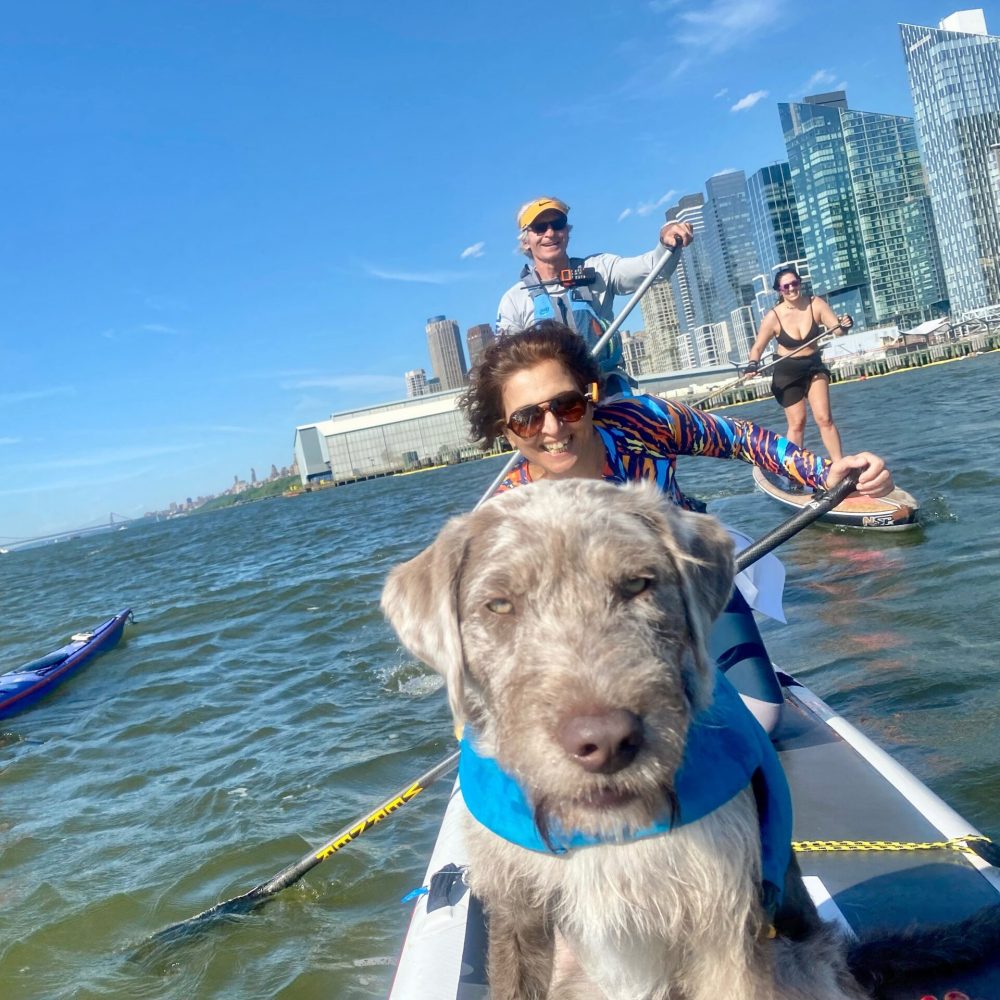
Charlie (pictured above) says, “Onward humans, onward!”

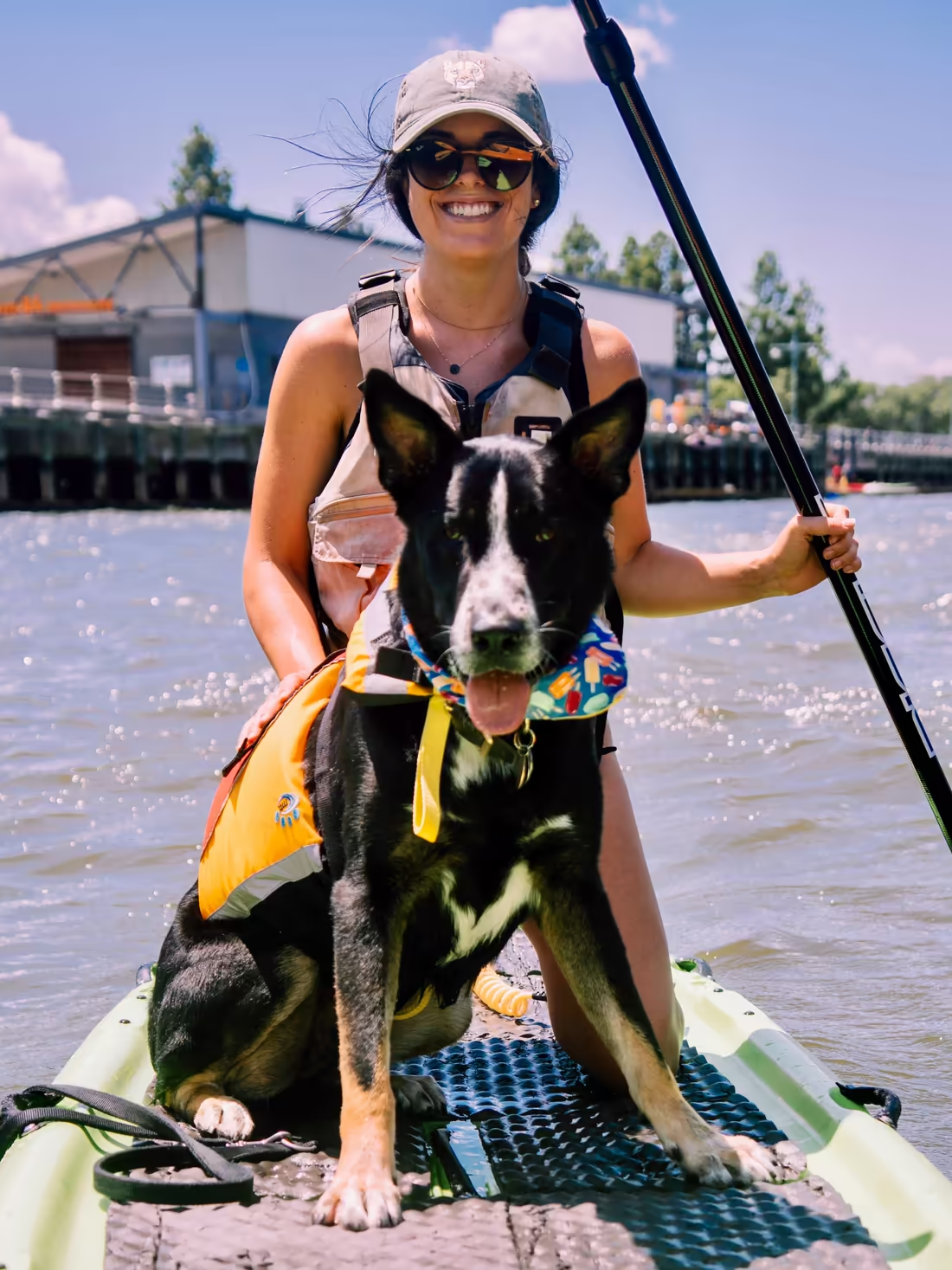
Kona (pictured above) says, “I will definitely find another lost shoe in this river…but that big green statue over there looks very interesting.”
It quickly became undeniable to me that this specific paddling discipline was finally going to capture New York’s collective attention as a bona fide fitness lifestyle, sitting right alongside running, cycling, rowing studios, outdoor bootcamps, and CrossFit. It provided a punishing, full-body, core-driven workout that simultaneously dialed in balance—all while being incredibly low-impact on your joints.
And best of all? It was outdoors in the fresh air and directly on the water!
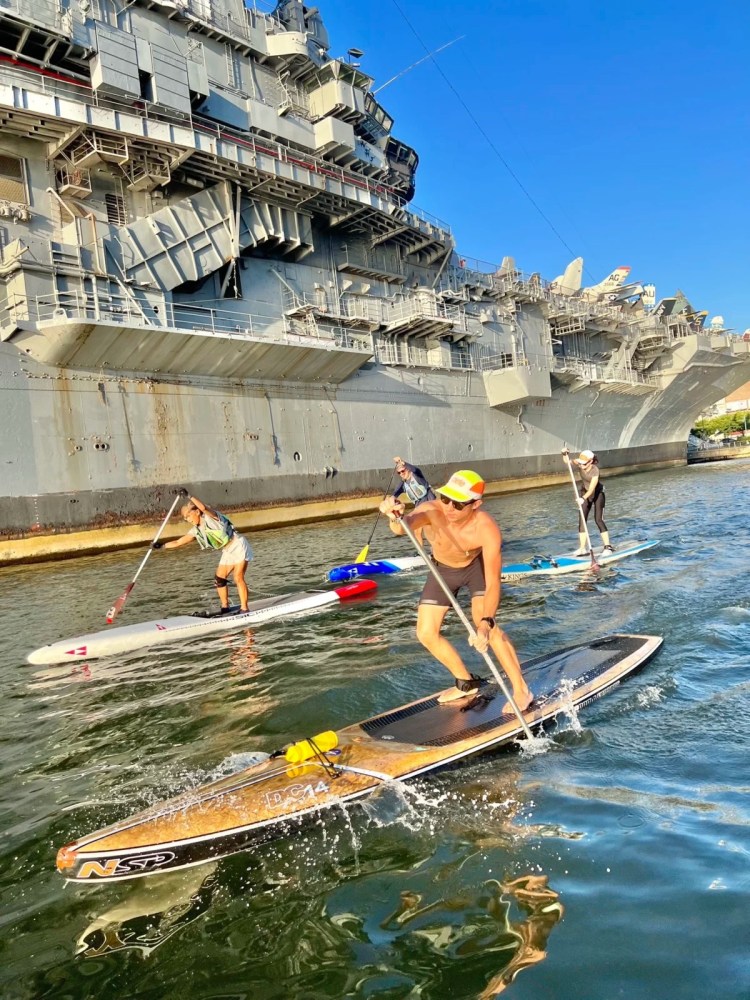
It doubled beautifully as a wellness activity, opening up space for floating yoga and deep restorative practices as well!
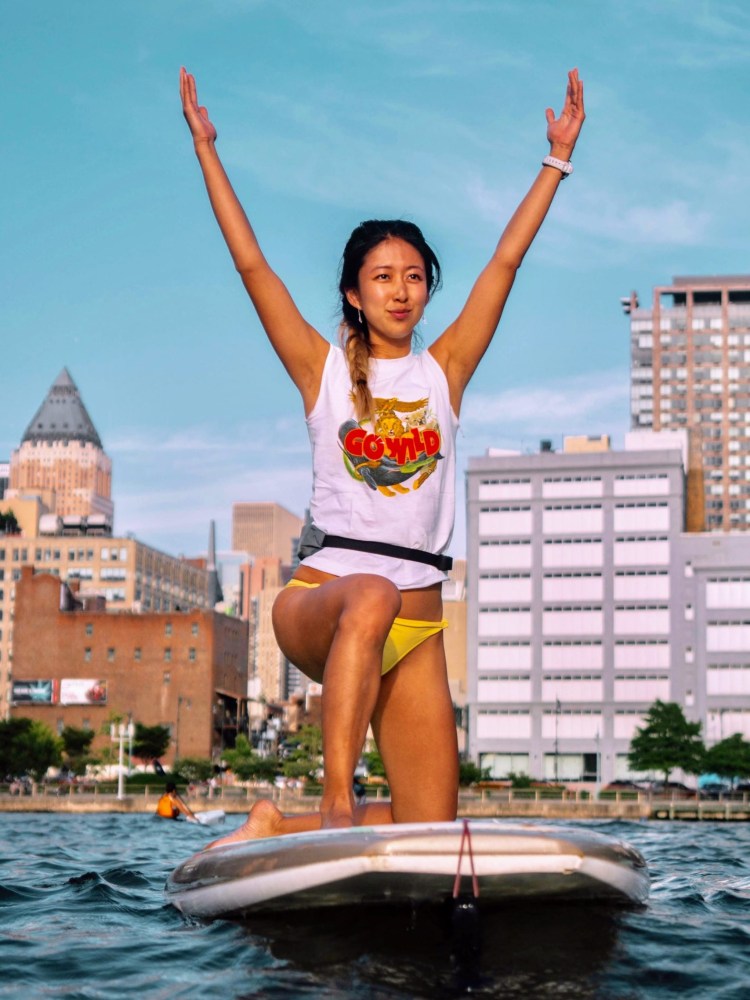
Judy Dong (pictured above) notes: “I love paddleboarding because there are so many different ways I can enjoy it. I can paddle at a super high intensity or just leisurely cruise around, all while being completely outdoors, soaking in the water and the skyline…”
The more your skills progressed, the more types of technical water conditions you could confidently navigate, and the further out you could travel!
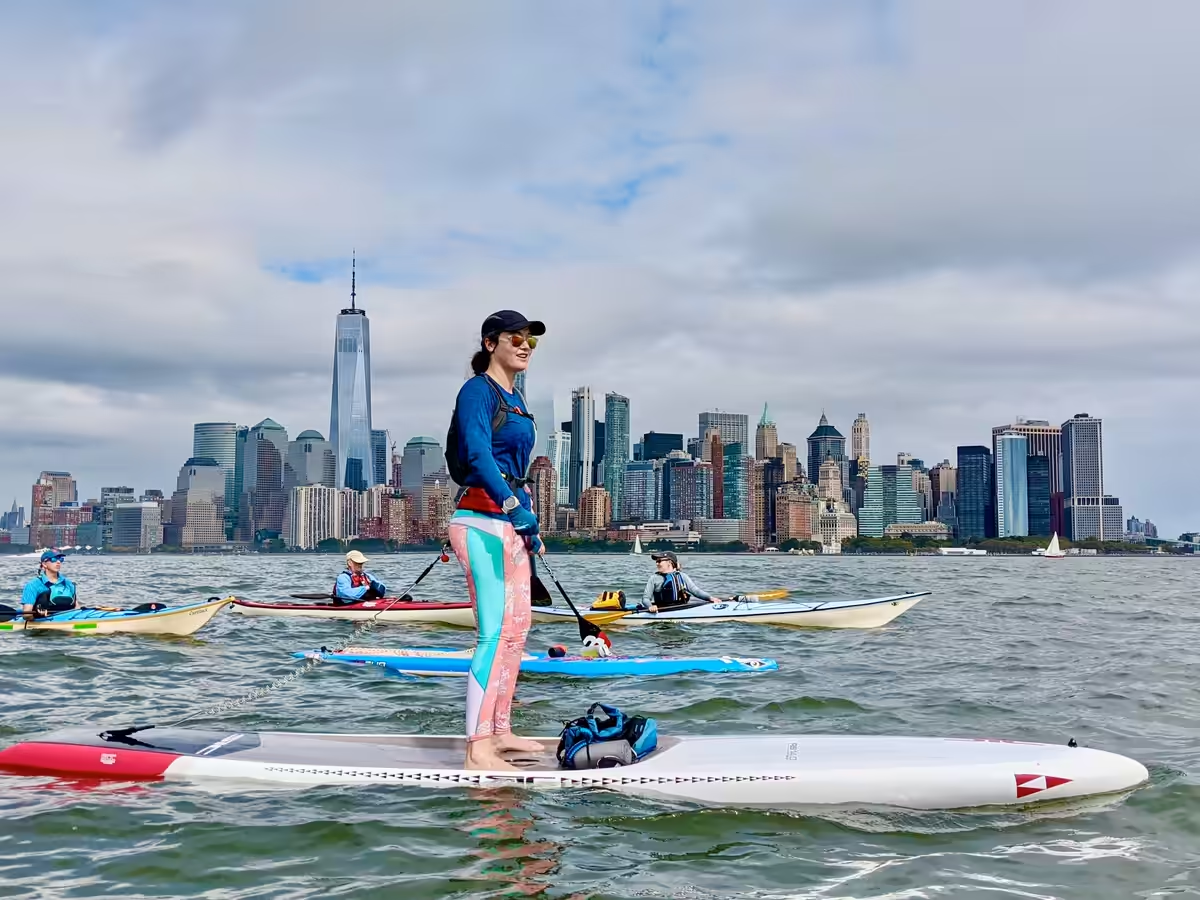
” Liz (above) says-“I love SUP because its everything I want from leisure time. It’s and intense workout (when you travel at speed), and it frees my mind for thought or enter a real flow state. It gets me into nature-standing up and leaving shore changes everything. You actually remember that New York is built inside a natural environment when you’re out there, closer to the eagles and the marine life. The time in nature, in the sun, on the water is great for my health. It’s a great way to get a sense of adventure in a way its hard to find in NYC-regularly, on every single outing. Last but not least , sharing these experiences with others in such a great community, fostering friendships, is the icing on the cake.”
With a great, modern, fast touring board coupled with clean form and solid baseline cardio, stand-up paddleboards could seamlessly join sea kayaks on our most ambitious long-distance trips—including the ultimate bucket-list challenge: the Manhattan Circumnavigation.

Sean Weber (above) adds: “Discovering SUP at MKC has given me the ability to explore NYC (and the rest of the world) from a uniquely special vantage point, providing an extreme sport that consistently expands the limits of my physical ability and mental fortitude.”
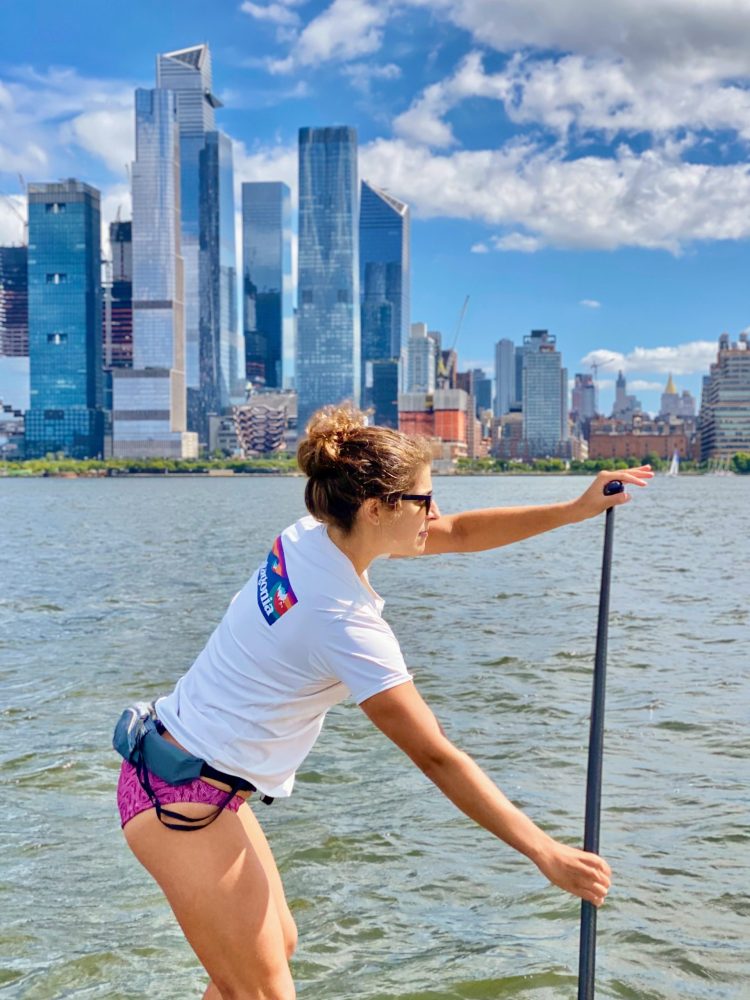
Stephanie Levine (above) says: “I love the absolute freedom that SUP provides. The minute you step out onto the water, everything else on land completely disappears.”
And let’s not forget the iconic Statue of Liberty trip…
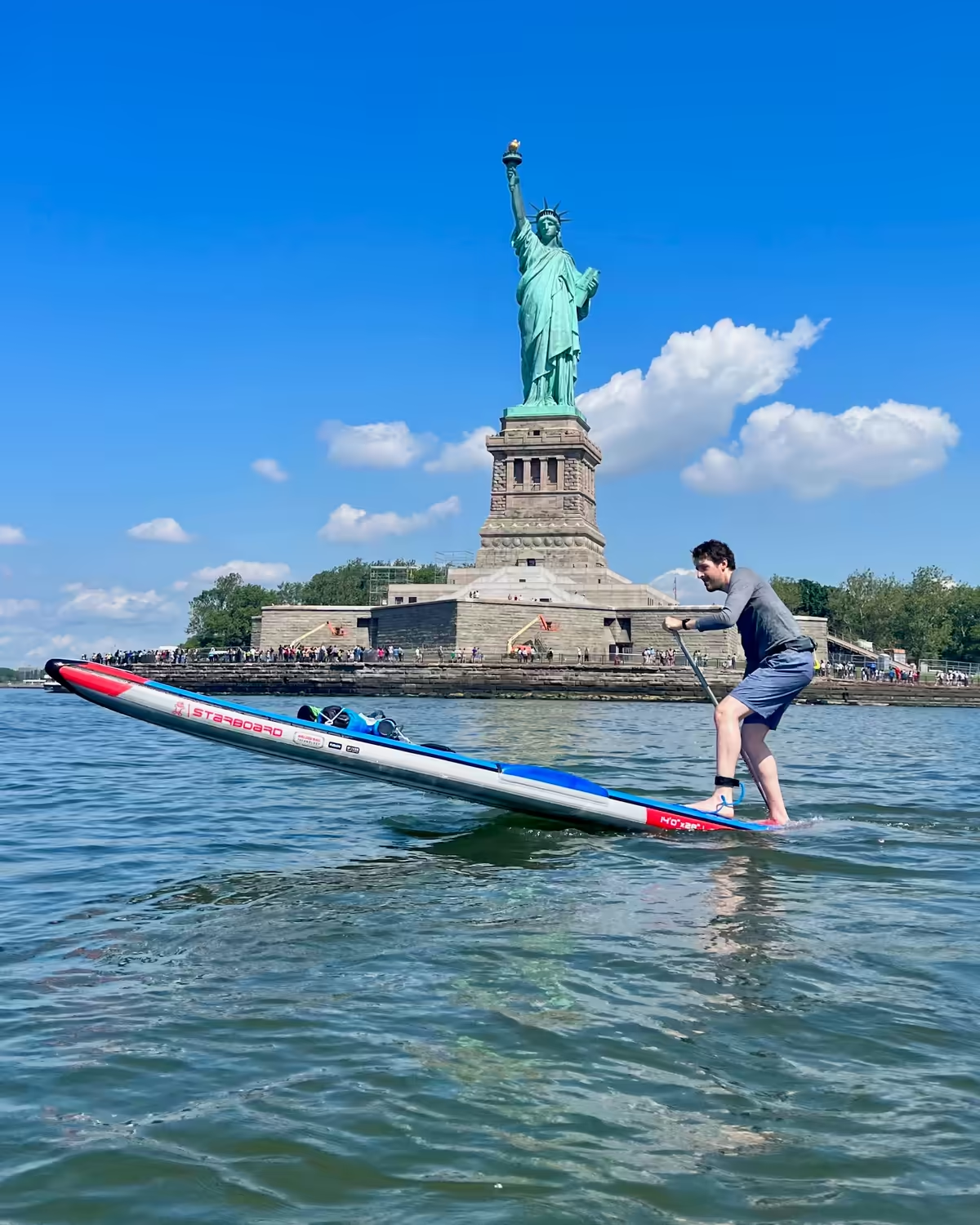
Alex Mark (above) shares: “Stand-up paddleboarding is one of only two forms of exercise I’ve ever truly loved. It’s an incredible full-body workout, intense on both cardio and strength, that leaves me feeling deeply invigorated rather than physically drained. It’s so flexible—I can commit to a day of hard interval training or take a more meandering ride using the current. I can easily find complete solitude on the river or travel with a great group of friends… SUP has been fantastic for both my mental and physical health!”
In fact, it would be about ten years before I sat down to kayak in a significant way again. A long-standing hip and glute issue built up from sitting inside kayak cockpits for 40 years vanished completely, and my overall fitness hit brand-new personal highs.
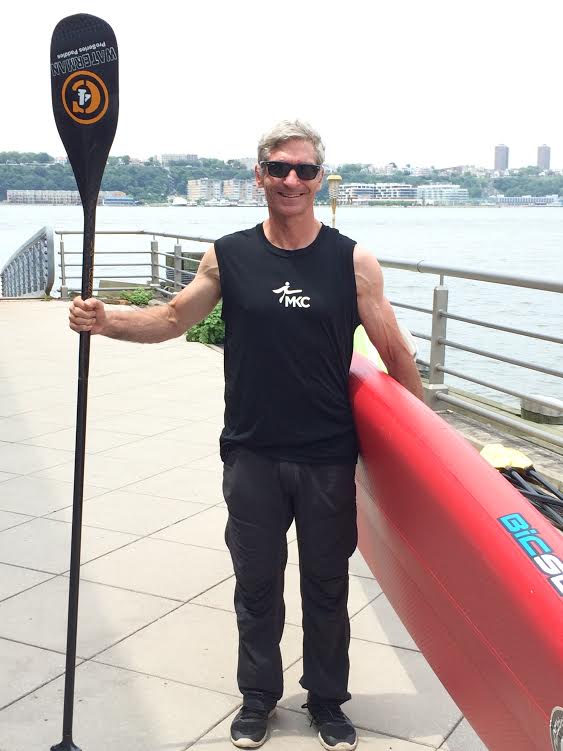
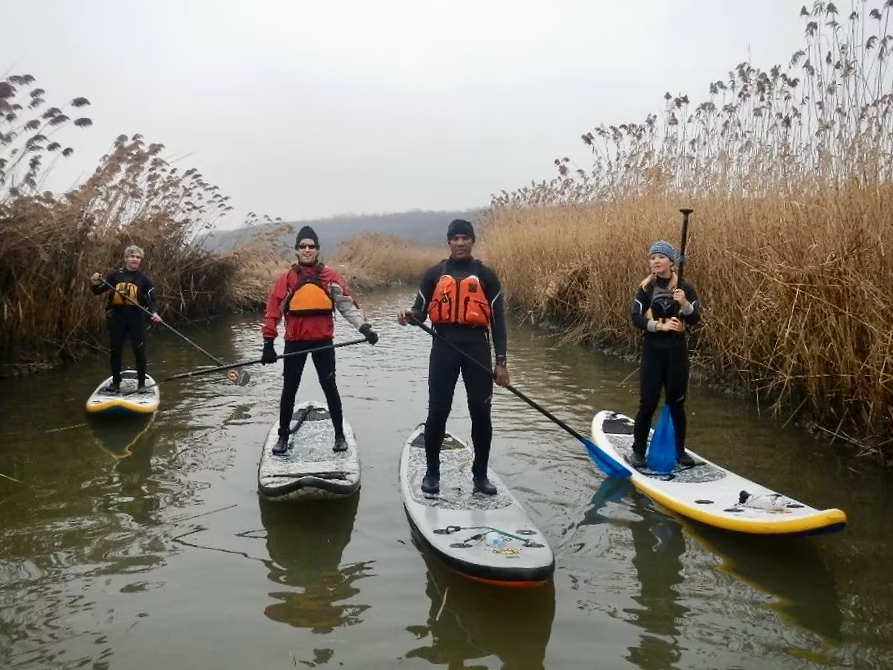
My core team—Carey, Shannon, Seth, and myself—started tossing iSUPs into car trunks and loading them into the bellies of airplanes to seek out wilderness adventures far beyond city lines.
Meanwhile, another absolute super-iSUP joined our specialized ranks: The Red Paddle Co Dragon. A blistering-fast, four-person inflatable multi-paddler board that actually spawned an international Dragon World Championship racing circuit designed explicitly around it.
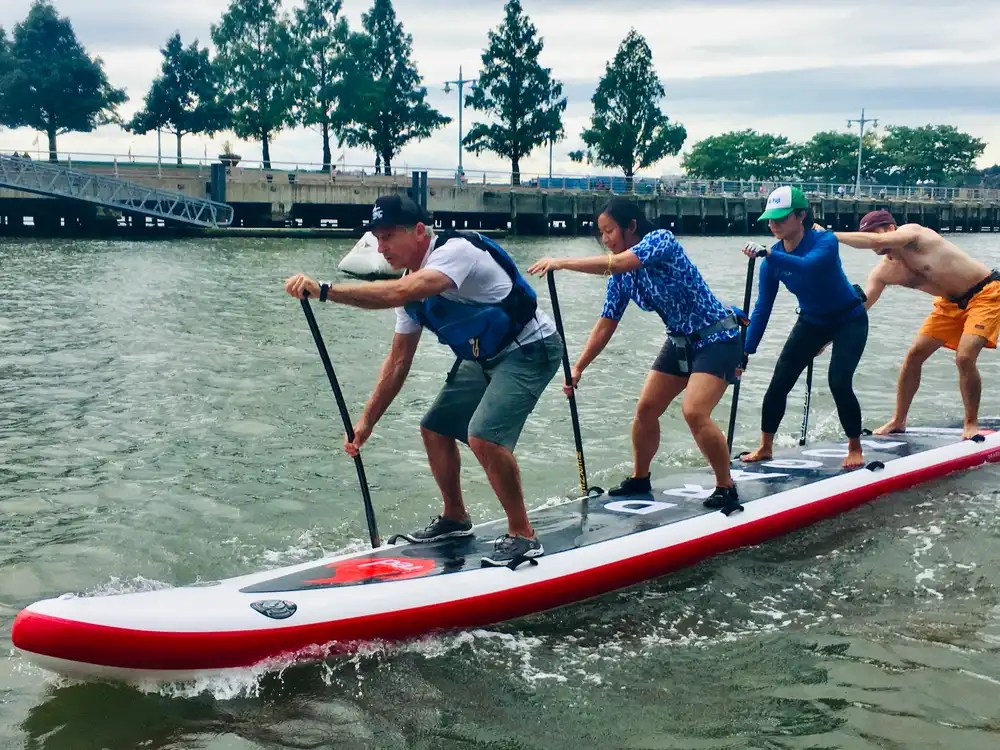
Chun Lee (third from the left) shares: “I love SUP because it effortlessly combines my love for the outdoors, fitness, and community—especially right here in Manhattan, where opportunities to find a single activity offering all three are incredibly limited.”
Make no mistake: the Dragon is not a beginner’s board by any standard, contrary to what you might initially expect given its immense length, width, and depth. The exact moment you add more than one body onto it, the entire exercise shifts to absolute synchronization, rhythm, balance, and cooperative flow. Any awkward micro-movement made by one paddler is instantly felt by everyone else on board.
But when you’re perfectly in sync? This massive machine absolutely flies once she accelerates up to speed. Carving it cleanly around race buoys is a genuine art form and a blast to practice.
It handles remarkably well in messy, open, bumpy water too. My crew and I actually completed the first-ever 4-person Dragon lap around the entirety of Manhattan island.
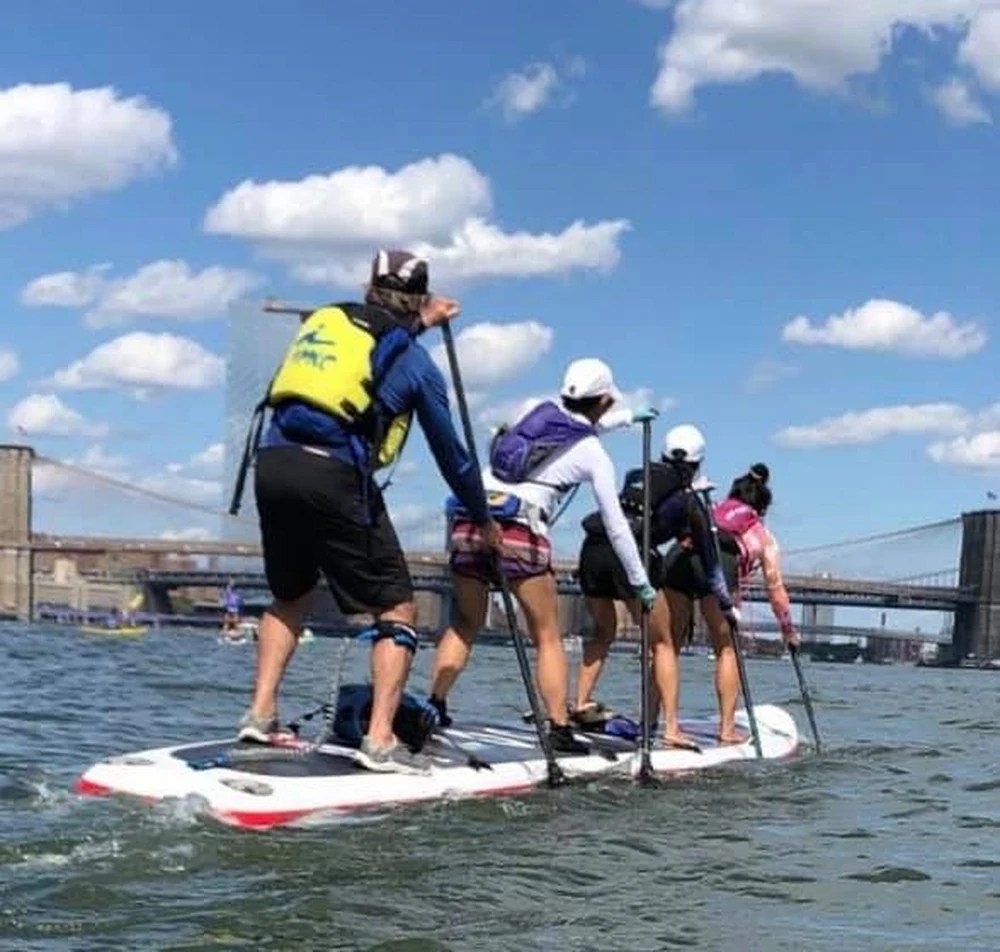
Our Dragon is still going strong at the boathouse, ready and waiting for new ambitious teams to come tame it.
We Are Pilgrims Master -We Will Always Go Further
How about shuffling off to Buffalo in Reverse 500+ Miles?
That what Paris Montoya did a about five years ago, he took his Starrboard ISUP and a couple of big waterproof drybags which his lashed to the deck and off he went, barely qualifying as a suitable craft for the laws of the Erie Canal’s 83 lock system.
He proceeded to navigate one of the most influential combination of waterways in the history of the United States and arguably the world in the 19th and much of 20th Century.
George Washington has imagined a canal across NY State and in 1825 the Erie Canal was completed.
The Canal unlocked the heartlands industry and agriculture of the midwest to NYC and then to the world.
NYC would then become Americas largest seaport.
It took took him 20 days, 10 days faster than the average cargo boat did when the canal first opened.
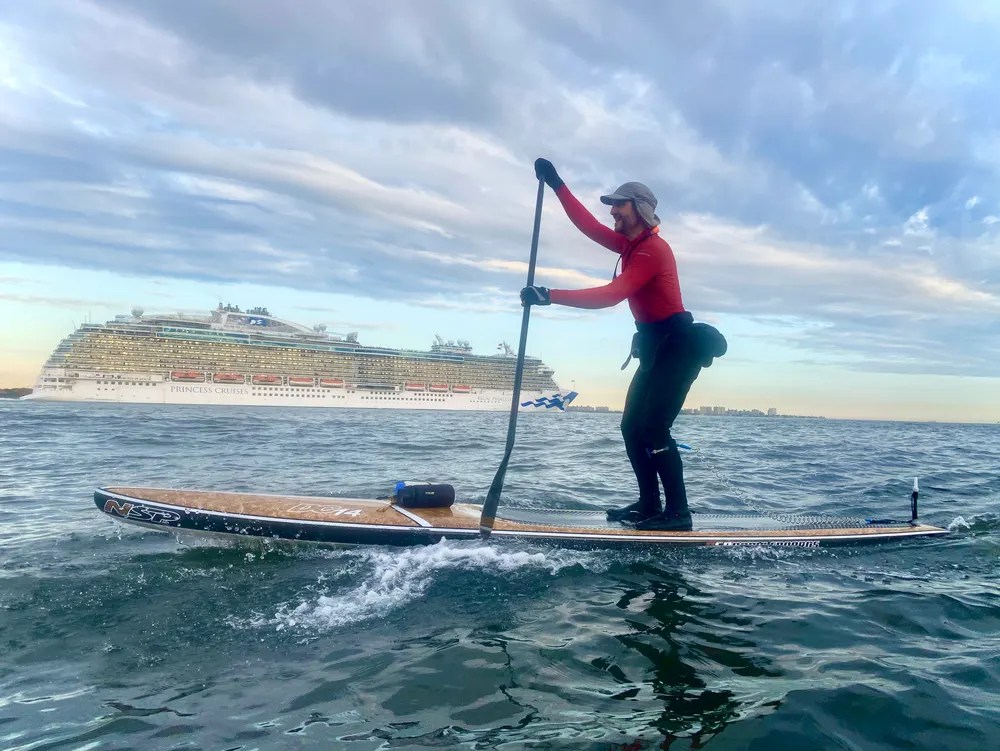
Paris (above) says- “SUPing in NYC grounds me in nature the minute I leave the pier head. The rivers and the waterways demand a balance of focus and ease. A mind/body experience that leaves me vibrant and restored. All while I take in the best views the city has to offer!”
Go to Miami for Valentines Day
Awesome!
It Only Takes 4 Months to Paddle There
On Columbus Day 2015 , two former MKC Sup and Kayak instructors, Jules Gismondi and LouAnne Harris , (the Atlantic Supper Girls) , finished loading their two 12’6″ long by 30 inch wide Bic Wing Stand Up Paddle Boards. It was’nt long before they said their goodbyes to friends and family and were heading south.
On Valentines Day 2016 they arrived in Miami after paddling 1500 miles self supported.
They said- ” We thought it was gong to get warmer the further south we went.” An important delusion to have for such and adventure.
They were even better friends after the trip than they were before and have a lifelong bond sealed with super glue and wrapped in gorilla tape.
Paddling Adventures of this magnitude are epic and life course changing.
Not everyone can do them but the call of the wild is hard to resist for some…
See This You Tube about it all.
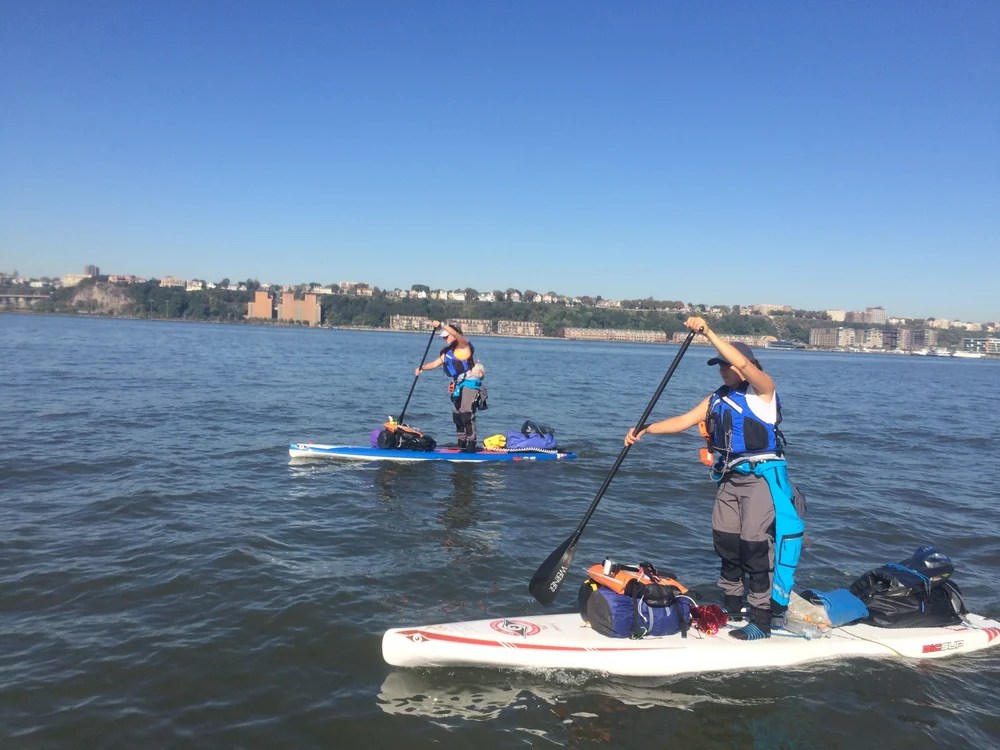
Jules (foreground) and LouAnne heading South From NYC. 1,500,000 strokes later they were in the Miami
The Great Shift: From the Kayak Academy to the Endless Paddleboard Playground
When I first established Manhattan Kayak, I approached things through a highly structured, professional framework. Before the era of ultra-recreational sit-on-top boats, the choppy water of the New York Harbor required technical mastery from day one. My new team and I built a flawless progression: Kayak 1, 2, and 3. It worked beautifully and still does. No need to fix it if it’s not broken. It systematically graduates everyday folks into confident sea kayakers who eventually conquered the Statue of Liberty or cross off that ultimate remember-it-forever experience: the full Manhattan Circumnavigation.
So, naturally, when the SUP revolution arrived, we built the exact same “Basics 1-2-3” academy framework. We expected the exact same results.
But SUP proved to be a completely different animal.
It has a steeper initial learning curve and demands a higher baseline of balance and core engagement. We watched as people fell off the track, grew demotivated, and stopped returning before graduating to the river. We realized we needed to meet New Yorkers exactly where they were—balancing the casual seekers who just want a vibrant community with the expert fitness junkies looking for a true physical sanctuary.
“Am I Going to Fall In?”
Let’s address the elephant in the room. A lot of New Yorkers look out at the Hudson River with a healthy dose of intimidation. Some worry about the dynamic water; others aren’t strong swimmers or fear pollution. They look at a stand-up paddleboard and think, “I’m just going to spend my entire day falling into the river.”
Here is the reality: Once you learn the fundamentals, you won’t.
Think about it like skiing. Do you expect a well-practiced skier to be constantly wiping out on their weekly runs? Of course not. They only fall if they are intentionally pushing themselves to their absolute physical edge in very difficult conditions. SUP is exactly the same. Sure, during your very first introductory sessions inside our protected cove, you are finding your center of gravity and might take a splash. That is just the early learning phase. But once your body learns how to execute micro-corrections and stays upright, it becomes second nature. By the time you graduate to our river trips, falling in is a rarity, not an expectation. You are in total control.
Calling All Runners, Cyclists, and HYROX Athletes: The Ultimate Unfair Advantage
New York City is arguably the endurance capital of the world. Right now, there are over 50,000 HYROX athletes in the city, thousands of marathon runners training on the West Side Highway, and endless cycling groups pushing their limits on the weekends. They monitor their heart rates, stare at their Strava analytics, and relentlessly search for the next performance edge.
But they are hitting a wall. Pavement pounding breaks down joints. Spin studios are dark and claustrophobic.
Here is our open invitation to the NYC fitness community: Stand-Up Paddleboarding is the ultimate low-impact, multi-planar cross-training alternative you’ve been missing.
When you stand on a board, executing a proper full-body forward stroke, you are building raw power from your toes to your fingertips. Your core is working in continuous micro-adjustments to manage the moving water, giving you unparalleled stabilizing strength that you simply cannot replicate on a gym floor or a glassy pond. It is pure cardio and raw muscle endurance, all taking place outside in the fresh air with the Hudson skyline as your backdrop. You get the data, the sweat, and the high-status athletic challenge—without the knee and lower-back wear and tear.
Our Brand-New Weekly SUP Progressions (No Pressure, All Fun)
To accommodate this cultural evolution, we cut the cord with our Kayak “1-2-3” playbook. Whether you want to leisurely hang out in an all-levels space or methodically train your way up to our intermediate+ Wednesday night Tempo and Thursday night Velocity paddles, we have built a non-linear, repeatable pathway just for you.
1. Paddleboard Intro (Saturday Mornings)
This is a 1.5-hour, zero-pressure class designed for complete beginners or anyone who has only done informal rentals in the past. Taught by Stacey and Marge, both deeply kind and empathetic coaches and professional dancers, this class is all about helping you find your center, click with your board, and learn to glide smoothly through the water.
2. Paddleboard Skills (Sunday Mornings)
Once you are comfortably gliding, you can choose to repeat the Intro or step up to our 2.5-hour Skills class with Judy. This session stays securely inside our cove, where we practice building efficiency. You can repeat this class as many Sundays as you like! We even have a fun challenge: we write names on a boathouse dry-erase board as paddlers work towards hitting a 17-minute mile. Doing four laps around the Intrepid equals exactly one nautical mile!
Why the 17-minute mile benchmark? To join our advanced tracks or open-river weekend trips, paddleboarders need to be at a safe baseline speed to seamlessly combine with our fast sea kayaks and surfskis. But there is absolutely no rush to get there. You own your progression.
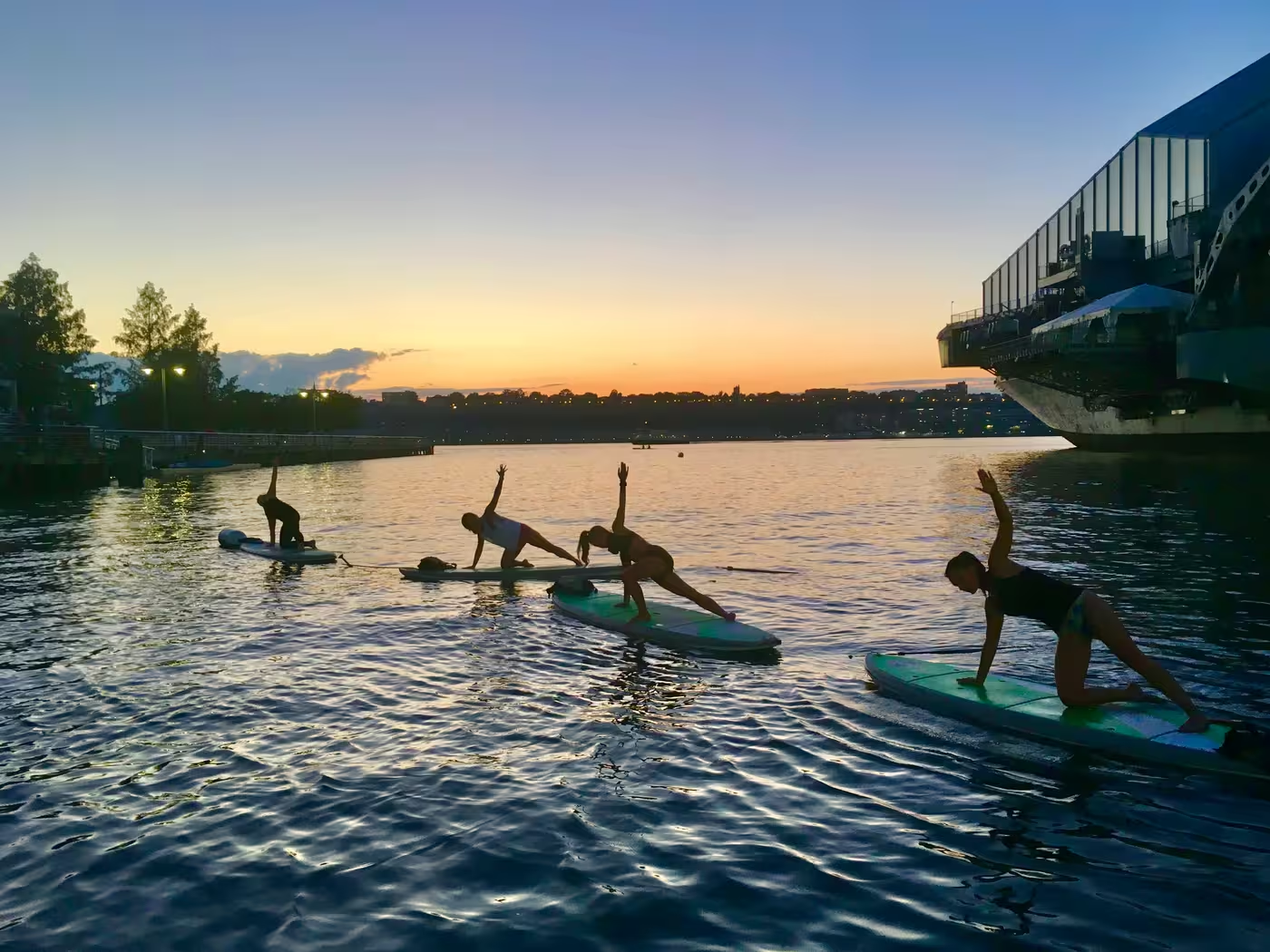
3. Paddleboard Stretch & Tone (Friday Evenings at Sunset)
Don’t want to get onto the high-intensity track at all? No problem! Our Friday night Sunset session features our brand-new Starburst floating yoga platform. Up to ten paddleboards can dock right into the platform simultaneously. It is social, it is low-pressure, and it is pure community. Stacey and Judy are dedicated to maintaining this restorative, welcoming space in our cool cove.
Feel the Open River When the Tides Are Right
For those in our Sunday Skills class who want a little taste of the big river without the pressure of a full intermediate tour, we watch the tides carefully. On optimal Sundays, we will run a special Open River Session. This lets you step out into the Hudson with a fully supportive group that is in the exact same learning stage as you, giving you a safe thrill without requiring a 17-minute mile clearance.
The Ultimate Summer Access: Our Unlimited Paddleboard Pass
Since rolling out this new program just last month, we’ve seen a spectacular wave of new faces. People who had been sitting on the sidelines because they felt intimidated by long river trips finally have a permanent forum to come hang out, get fit, and build community with us every week.
To make it as easy as possible to integrate SUP into your weekly New York routine, we are now offering our Unlimited Paddleboard Pass for just $195 a month. This pass gives you 30 days of unlimited access to our Wednesday and Thursday evening paddles, Friday evening Stretch & Tone, Saturday morning Intros, and Sunday morning Skills classes completely free (river trips are excluded due to their varying lengths).
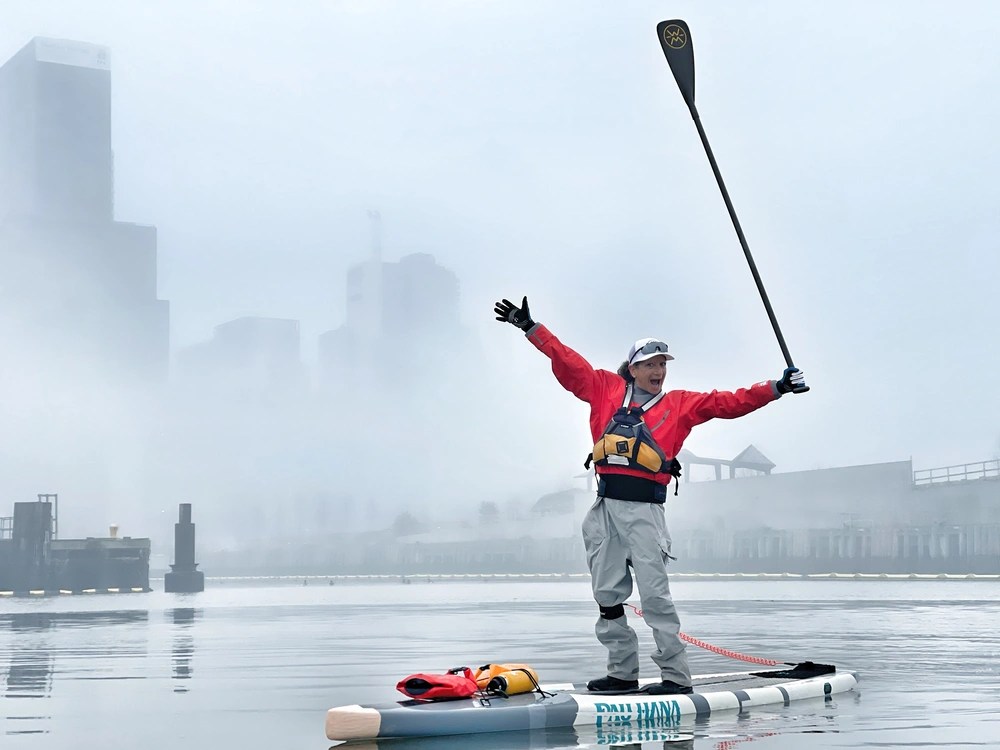
Endurance athlete Stefani Jackenthal perfectly summarizes that magical intersection of human technique, advanced board design, and the ultimate liquid playground:
What I love about paddling my SUP on the Hudson River is the freedom and adventure. Each paddle is an instant escape from city living and an entry into nature… I often paddle north against the current, getting a great strength and cardio workout, and then take Mother Nature’s awesome, powerful ‘magic carpet’ ride south with the ebb. Although I’ve been paddling on the Hudson for nearly 30 years, I still get giddy standing on my board, surrounded by the undulating sparkly water and feeling dwarfed by the diverse, towering skylines.
As a multi-sport athlete, the core-integration from paddling helps me balance in yoga, and the countless SUP squats on bouncy water from boat wakes strengthens my glutes, quads, and calves—a terrific complement to my running and cycling. I also paddle a tippy surfski… and I love the mind-body balance of using both vessels and the different POVs of sitting at water-level versus standing on my SUP. Another fun bonus? It’s fantastic for developing cocktail dress arms! I’ll cheers to that!
Whether your goal is to have me coach you up to the perfect forward stroke for your next race, or you just want to sit on a board at sunset and chill with great people in a quiet cove, your community is waiting right here at our boathouse. Come join me on the water.